Consider the gas-phase reaction: H2(g) + I2(g) → 2 HI(g) The reaction was experimentally determined to be first order in H2 and first order in I2. Consider the proposed mechanisms. Proposed mechanism I: H2(g) + I2(g) → 2 HI(g) Single step Proposed mechanism II: I2(g) Δk1k-12 I(g) Fast H2( g) + 2 I( g) → k22 HI( g) Slow b. What kind of experimental evidence might lead you to favor mechanism II over mechanism I?
Ch.15 - Chemical Kinetics

Chapter 15, Problem 109
Anthropologists can estimate the age of a bone or other sample of organic matter by its carbon-14 content. The carbon-14 in a living organism is constant until the organism dies, after which carbon- 14 decays with first-order kinetics and a half-life of 5730 years. Suppose a bone from an ancient human contains 19.5% of the C-14 found in living organisms. How old is the bone?
Verified step by step guidance1
Identify that the problem involves radioactive decay, which follows first-order kinetics.
Use the formula for first-order decay: \( N_t = N_0 e^{-kt} \), where \( N_t \) is the remaining quantity of substance, \( N_0 \) is the initial quantity, \( k \) is the rate constant, and \( t \) is time.
Recognize that the half-life \( t_{1/2} \) is related to the rate constant \( k \) by the equation \( k = \frac{0.693}{t_{1/2}} \).
Substitute the given half-life of 5730 years into the equation to find \( k \).
Use the percentage of carbon-14 remaining (19.5%) to solve for \( t \) in the decay formula, where \( N_t/N_0 = 0.195 \).

Verified video answer for a similar problem:
This video solution was recommended by our tutors as helpful for the problem above.
Was this helpful?
Key Concepts
Here are the essential concepts you must grasp in order to answer the question correctly.
Carbon-14 Dating
Carbon-14 dating is a radiometric dating method used to determine the age of organic materials by measuring the amount of carbon-14 they contain. Living organisms maintain a constant level of carbon-14, but once they die, this isotope begins to decay at a known rate, characterized by its half-life.
Recommended video:
Guided course
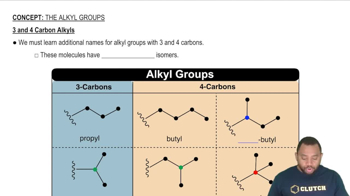
3 and 4 Carbon Alkyls
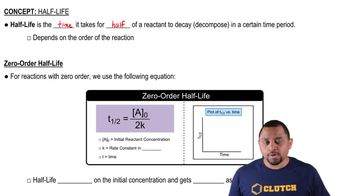
Half-Life
The half-life of a radioactive isotope is the time required for half of the isotope in a sample to decay. For carbon-14, this half-life is approximately 5730 years, meaning that after this period, only half of the original carbon-14 remains in the sample, allowing scientists to estimate the age of the sample based on the remaining carbon-14 content.
Recommended video:
Guided course
Zero-Order Half-life
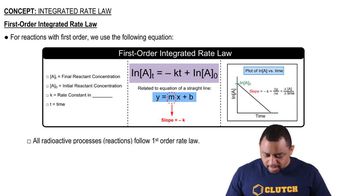
First-Order Kinetics
First-order kinetics refers to a type of reaction rate that is directly proportional to the concentration of one reactant. In the context of carbon-14 decay, this means that the rate at which carbon-14 decays is proportional to the amount of carbon-14 present, allowing for predictable calculations of age based on the remaining percentage of carbon-14 in a sample.
Recommended video:
Guided course
First-Order Reactions
Related Practice
Textbook Question
1632
views
Textbook Question
This reaction has an activation energy of zero in the gas phase: CH3 + CH3 → C2H6
a. Would you expect the rate of this reaction to change very much with temperature?
1
views
Textbook Question
Consider the two reactions:
O + N2 → NO + N Ea = 315 kJ/mol
Cl + H2 → HCl + H Ea = 23 kJ/mol
a. Why is the activation barrier for the first reaction so much higher than that for the second?
561
views
Textbook Question
Consider the two reactions:
O + N2 → NO + N Ea = 315 kJ/mol
Cl + H2 → HCl + H Ea = 23 kJ/mol
b. The frequency factors for these two reactions are very close to each other in value. Assuming that they are the same, calculate the ratio of the reaction rate constants for these two reactions at 25 °C.
689
views
