
Textbook Question
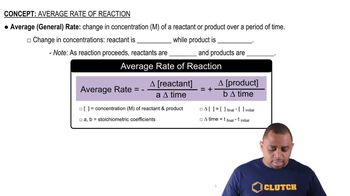
Consider the reaction: 8 H2S(g) + 4 O2(g) → 8 H2O(g) + S8(g) Complete the table.
1254
views

 Verified step by step guidance

 01:16
01:16
 02:03
02:03 01:53
01:53Consider the reaction: 8 H2S(g) + 4 O2(g) → 8 H2O(g) + S8(g) Complete the table.
Consider the reaction: 2 N2O( g) → 2 N2(g) + O2(g) a. Express the rate of the reaction in terms of the change in concentration of each of the reactants and products.
Consider the reaction:
2 HBr (g) → H2 (g) + Br2 (g)
a. Express the rate of the reaction in terms of the change in concentration of each of the reactants and products.
Consider the reaction: C4H8( g) → 2 C2H4( g) The tabulated data were collected for the concentration of C2H4 as a function of time: a. What is the average rate of the reaction between 0 and 10 s? Between 40 and 50 s?
Consider the reaction:
2 HBr (g) → H2 (g) + Br2 (g)
b. In the first 20.0 s of this reaction, the concentration of HBr dropped from 0.600 M to 0.512 M. Calculate the average rate of the reaction during this time interval.