The tabulated data were collected for this reaction at 500 °C: CH3CN(g) → CH3NC( g) a. Determine the order of the reaction and the value of the rate constant at this temperature.
Ch.15 - Chemical Kinetics

Chapter 15, Problem 87
Suppose that a catalyst lowers the activation barrier of a reaction from 125 kJ/mol to 55 kJ/mol. By what factor would you expect the reaction rate to increase at 25 °C? (Assume that the frequency factors for the catalyzed and uncatalyzed reactions are identical.)
Verified step by step guidance1
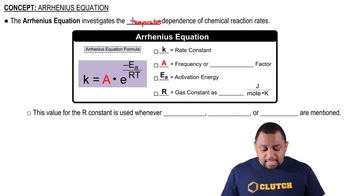
Identify the Arrhenius equation: \(k = A e^{-\frac{E_a}{RT}}\), where \(k\) is the rate constant, \(A\) is the frequency factor, \(E_a\) is the activation energy, \(R\) is the gas constant (8.314 J/mol·K), and \(T\) is the temperature in Kelvin.
Convert the temperature from Celsius to Kelvin: \(T = 25 + 273.15 = 298.15\) K.
Calculate the rate constant for the uncatalyzed reaction using the activation energy \(E_{a1} = 125\) kJ/mol. Convert \(E_{a1}\) to J/mol: \(E_{a1} = 125,000\) J/mol.
Calculate the rate constant for the catalyzed reaction using the activation energy \(E_{a2} = 55\) kJ/mol. Convert \(E_{a2}\) to J/mol: \(E_{a2} = 55,000\) J/mol.
Determine the factor by which the reaction rate increases by taking the ratio of the rate constants: \(\frac{k_2}{k_1} = \frac{A e^{-\frac{E_{a2}}{RT}}}{A e^{-\frac{E_{a1}}{RT}}} = e^{-\frac{E_{a2} - E_{a1}}{RT}}\).
Key Concepts
Here are the essential concepts you must grasp in order to answer the question correctly.
Activation Energy
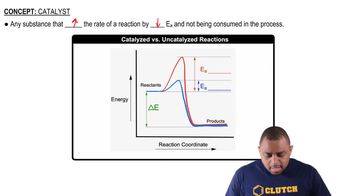
Activation energy is the minimum energy required for a chemical reaction to occur. It represents the energy barrier that reactants must overcome to form products. Lowering the activation energy, as a catalyst does, increases the number of reactant molecules that can successfully collide and react, thereby increasing the reaction rate.
Recommended video:
Guided course
Activity Series Chart
Arrhenius Equation
The Arrhenius equation describes the temperature dependence of reaction rates and is given by k = A * e^(-Ea/RT), where k is the rate constant, A is the frequency factor, Ea is the activation energy, R is the gas constant, and T is the temperature in Kelvin. This equation shows that a decrease in activation energy (Ea) leads to an exponential increase in the rate constant (k), which directly correlates to an increase in reaction rate.
Recommended video:
Guided course
Arrhenius Equation
Catalysis
Catalysis is the process of increasing the rate of a chemical reaction by adding a substance called a catalyst, which is not consumed in the reaction. Catalysts work by providing an alternative reaction pathway with a lower activation energy, allowing more reactant molecules to participate in the reaction at a given temperature, thus enhancing the overall reaction rate.
Recommended video:
Guided course
Catalyzed vs. Uncatalyzed Reactions
Related Practice
Textbook Question
1711
views
Textbook Question
Many heterogeneous catalysts are deposited on high-surfacearea supports. Why?
626
views
1
rank
Textbook Question
Suppose that the reaction A¡products is exothermic and has an activation barrier of 75 kJ/mol. Sketch an energy diagram showing the energy of the reaction as a function of the progress of the reaction. Draw a second energy curve showing the effect of a catalyst.
935
views
Textbook Question
The activation barrier for the hydrolysis of sucrose into glucose and fructose is 108 kJ/mol. If an enzyme increases the rate of the hydrolysis reaction by a factor of 1 million, how much lower must the activation barrier be when sucrose is in the active site of the enzyme? (Assume that the frequency factors for the catalyzed and uncatalyzed reactions are identical and a temperature of 25 °C.)
1809
views