
The desorption (leaving of the surface) of a single molecular layer of n-butane from a single crystal of aluminum oxide is found to be first order with a rate constant of 0.128/s at 150 K. b. If the surface is initially completely covered with n-butane at 150 K, how long will it take for 25% of the molecules to desorb (leave the surface)? For 50% to desorb?

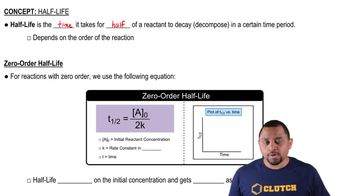
The evaporation of a 120-nm film of n-pentane from a single crystal of aluminum oxide is zero order with a rate constant of 1.92⨉1013 molecules/cm2•s at 120 K. a. If the initial surface coverage is 8.9⨉1016 molecules/cm2, how long will it take for one-half of the film to evaporate?
Verified step by step guidance
Verified video answer for a similar problem:
Key Concepts
Zero-Order Kinetics
Half-Life in Zero-Order Reactions
Surface Coverage
This reaction has an activation energy of zero in the gas phase: CH3 + CH3 → C2H6
a. Would you expect the rate of this reaction to change very much with temperature?
The kinetics of this reaction were studied as a function of temperature. (The reaction is first order in each reactant and second order overall.)
C2H5Br(aq) + OH- (aq) → C2H5OH(l) + Br- (aq)
Temperature (°C) k (L,mol •s)
25 8.81⨉10-5
35 0.000285
45 0.000854
55 0.00239
65 0.00633
b. Determine the rate constant at 15 °C.
Consider the two reactions:
O + N2 → NO + N Ea = 315 kJ/mol
Cl + H2 → HCl + H Ea = 23 kJ/mol
a. Why is the activation barrier for the first reaction so much higher than that for the second?
Consider the reaction in which HCl adds across the double bond of ethene: HCl + H2C=CH2 → H3C-CH2Cl The following mechanism, with the accompanying energy diagram, has been suggested for this reaction:
Step 1 HCl + H2C=CH2 → H3C=CH2+ + Cl-
Step 2 H3C=CH2+ + Cl- → H3C-CH2Cl
b. What is the expected order of the reaction based on the proposed mechanism?
