
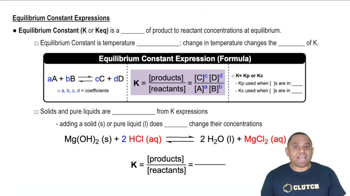
Silver sulfate dissolves in water according to the reaction: Ag2SO4(s) ⇌ 2Ag+(aq) + SO42-(aq) Kc = 1.1 * 10-5 at 298K A 1.5-L solution contains 5.14 g of dissolved silver sulfate. If additional solid silver sulfate is added to the solution, will it dissolve?

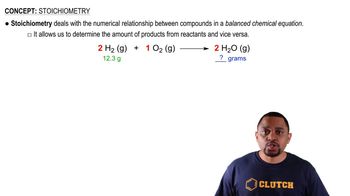
Consider the reaction: H2(g) + I2(g) ⇌ 2 HI(g). A reaction mixture in a 3.67-L flask at a certain temperature initially contains 0.763 g H2 and 96.9 g I2. At equilibrium, the flask contains 90.4 g HI. Calculate the equilibrium constant (Kc) for the reaction at this temperature.
Verified step by step guidanceKey Concepts
Equilibrium Constant (Kc)
Stoichiometry
Equilibrium Position
Consider the reaction: SO2Cl2(g) ⇌ SO2(g) + Cl2(g) Kp = 2.91*10^3 at 298 K In a reaction at equilibrium, the partial pressure of SO2 is 117 torr and that of Cl2 is 205 torr. What is the partial pressure of SO2Cl2 in this mixture?
Consider the reaction:
NH4HS(s)ΔNH3( g) + H2S( g)
At a certain temperature, Kc = 8.5 * 10 - 3. A reaction mixture at this temperature containing solid NH4HS has [NH3] = 0.0822 M and [H2S] = 0.0822M. Will more of the solid form, or will some of the existing solid decompose as equilibrium is reached?
Consider the reaction:
2 NO( g) + Br2( g)Δ2 NOBr( g) Kp = 28.4 at 298 K
In a reaction mixture at equilibrium, the partial pressure of NO is 125 torr and that of Br2 is 148 torr. What is the partial pressure of NOBr in this mixture?
