
For the reaction shown here, Kc = 255 at 1000 K. CO(g) + Cl2(g) ⇌ COCl2(g) If a reaction mixture initially contains a CO concentration of 0.1500 M and a Cl2 concentration of 0.175 M at 1000 K, what are the equilibrium concentrations of CO, Cl2, and COCl2 at 1000 K?
Ch.16 - Chemical Equilibrium

Chapter 16, Problem 60
Consider the reaction: SO2Cl2(g) ⇌ SO2(g) + Cl2(g) Kc = 2.99⨉10-7 at 227 °C If a reaction mixture initially contains 0.175 M SO2Cl2, what is the equilibrium concentration of Cl2 at 227 °C?
Verified step by step guidance1
Step 1: Write the expression for the equilibrium constant (Kc) for the reaction. For the reaction SO2Cl2(g) ⇌ SO2(g) + Cl2(g), the expression is Kc = [SO2][Cl2] / [SO2Cl2].
Step 2: Set up an ICE (Initial, Change, Equilibrium) table to track the concentrations of reactants and products. Initially, [SO2Cl2] = 0.175 M, and [SO2] = [Cl2] = 0 M.
Step 3: Let 'x' be the change in concentration of SO2Cl2 that reacts to reach equilibrium. At equilibrium, [SO2Cl2] = 0.175 - x, [SO2] = x, and [Cl2] = x.
Step 4: Substitute the equilibrium concentrations into the Kc expression: Kc = (x)(x) / (0.175 - x).
Step 5: Solve the equation for x, which represents the equilibrium concentration of Cl2.

Verified video answer for a similar problem:
This video solution was recommended by our tutors as helpful for the problem above.
Video duration:
7mWas this helpful?
Key Concepts
Here are the essential concepts you must grasp in order to answer the question correctly.
Chemical Equilibrium
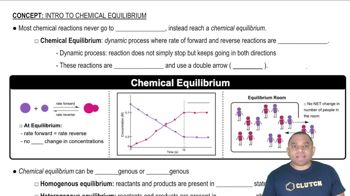
Chemical equilibrium occurs when the rates of the forward and reverse reactions are equal, resulting in constant concentrations of reactants and products. In this state, the system is dynamic, meaning that reactions continue to occur, but there is no net change in concentration. Understanding this concept is crucial for analyzing equilibrium constants and predicting the behavior of reactions.
Recommended video:
Guided course
Chemical Equilibrium Concepts
Equilibrium Constant (Kc)
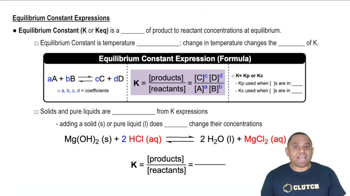
The equilibrium constant (Kc) quantifies the ratio of the concentrations of products to reactants at equilibrium for a given reaction at a specific temperature. For the reaction SO2Cl2(g) ⇌ SO2(g) + Cl2(g), Kc = [SO2][Cl2]/[SO2Cl2]. A small Kc value, like 2.99 * 10^-7, indicates that at equilibrium, the concentration of reactants is much greater than that of products, suggesting that the reaction favors the reactants.
Recommended video:
Guided course
Equilibrium Constant Expressions
ICE Table (Initial, Change, Equilibrium)
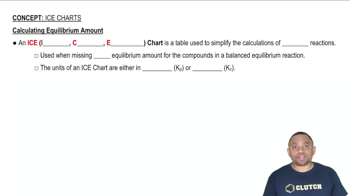
An ICE table is a tool used to organize the initial concentrations, changes in concentrations, and equilibrium concentrations of reactants and products in a chemical reaction. By setting up an ICE table for the given reaction, one can systematically determine the equilibrium concentrations based on the initial conditions and the equilibrium constant. This method simplifies the calculations needed to find unknown concentrations at equilibrium.
Recommended video:
Guided course
ICE Charts and Equilibrium Amount
Related Practice
Textbook Question
3268
views
1
rank
Textbook Question
Consider the reaction: A(g) ⇌ B(g) + C(g) Find the equilibrium concentrations of A, B, and C for each value of Kc. Assume that the initial concentration of A in each case is 1.0 M and that the reaction mixture initially contains no products. Make any appropriate simplifying assumptions. b. Kc = 0.010
4059
views
1
rank
Textbook Question
Consider the reaction: HC2H3O2(aq) + H2O(l) ⇌ H3O+(aq) + C2H3O2-(aq) Kc = 1.8⨉10-5 at 25°C If a solution initially contains 0.210 M HC2H3O2, what is the equilibrium concentration of H3O+ at 25 °C?
3717
views
