
Carbon monoxide and chlorine gas react to form phosgene: CO(g) + Cl2(g) ⇌ COCl2(g) Kp = 3.10 at 700 K If a reaction mixture initially contains 215 torr of CO and 245 torr of Cl2, what is the mole fraction of COCl2 when equilibrium is reached?
Ch.16 - Chemical Equilibrium

Chapter 16, Problem 87
Is Ammonia synthesized according to the reaction N2(g) + 3H2(g) ⇌ 2NH3(g) with Kp = 5.3 * 10^-5 at 725K?
Verified step by step guidance1
Identify the reaction: \( N_2(g) + 3H_2(g) \rightleftharpoons 2NH_3(g) \).
Understand that \( K_p \) is the equilibrium constant for the reaction in terms of partial pressures, given as \( 5.3 \times 10^{-5} \) at 725K.
Write the expression for \( K_p \) for the reaction: \( K_p = \frac{{(P_{NH_3})^2}}{{(P_{N_2})(P_{H_2})^3}} \).
Determine the partial pressures of \( N_2 \), \( H_2 \), and \( NH_3 \) at equilibrium if not provided, or assume initial conditions to calculate them.
Substitute the partial pressures into the \( K_p \) expression to check if the calculated \( K_p \) matches the given \( 5.3 \times 10^{-5} \).
Key Concepts
Here are the essential concepts you must grasp in order to answer the question correctly.
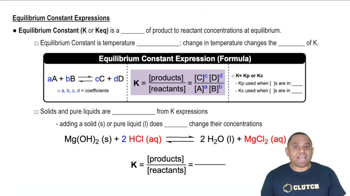
Equilibrium Constant (Kp)
The equilibrium constant (Kp) is a numerical value that expresses the ratio of the concentrations of products to reactants at equilibrium for a given reaction at a specific temperature. For gaseous reactions, Kp is calculated using partial pressures. A small Kp value, like 5.3 * 10^-5, indicates that at equilibrium, the concentration of reactants is much greater than that of products, suggesting that the reaction favors the reactants.
Recommended video:
Guided course
Equilibrium Constant Expressions
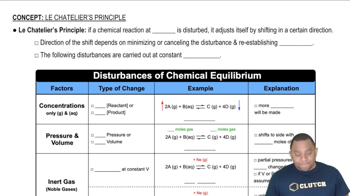
Le Chatelier's Principle
Le Chatelier's Principle states that if a dynamic equilibrium is disturbed by changing the conditions, the system will adjust itself to counteract the change and restore a new equilibrium. This principle helps predict how changes in concentration, pressure, or temperature will affect the position of equilibrium in a reaction, such as the synthesis of ammonia from nitrogen and hydrogen.
Recommended video:
Guided course
Le Chatelier's Principle
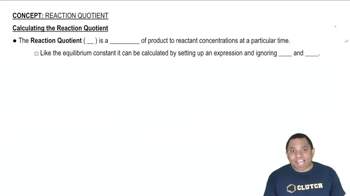
Reaction Quotient (Q)
The reaction quotient (Q) is a measure of the relative amounts of products and reactants at any point in a reaction, not just at equilibrium. It is calculated using the same formula as Kp but with the current concentrations or partial pressures. By comparing Q to Kp, one can determine the direction in which the reaction will proceed to reach equilibrium: if Q < Kp, the reaction will shift to the right (toward products), and if Q > Kp, it will shift to the left (toward reactants).
Recommended video:
Guided course
Reaction Quotient Q
Related Practice
Textbook Question
3946
views
Textbook Question
Consider the endothermic reaction: C2H4(g) + I2(g) ⇌ C2H4I2(g) If you were trying to maximize the amount of C2H4I2 produced, which tactic might you try? Assume that the reaction mixture reaches equilibrium. a. decreasing the reaction volume b. removing I2 from the reaction mixture c. raising the reaction temperature d. adding C2H4 to the reaction mixture
1517
views
Textbook Question
At 70 K, CCl4 decomposes to carbon and chlorine. The Kp for the decomposition is 0.76. Find the starting pressure of CCl4 at this temperature that will produce a total pressure of 1.0 atm at equilibrium.
1646
views
