
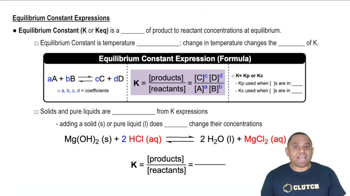
This reaction has an equilibrium constant of Kp = 2.2⨉106 at 298 K. 2 COF2(g) ⇌ CO2(g) + CF4(g) Calculate Kp for each reaction and predict whether reactants or products will be favored at equilibrium.
b. 6 COF2(g) ⇌ 3 CO2(g) + 3 CF4(g)

Verified step by step guidanceThis reaction has an equilibrium constant of Kp = 2.2⨉106 at 298 K. 2 COF2(g) ⇌ CO2(g) + CF4(g) Calculate Kp for each reaction and predict whether reactants or products will be favored at equilibrium.
b. 6 COF2(g) ⇌ 3 CO2(g) + 3 CF4(g)
This reaction has an equilibrium constant of Kp = 2.26⨉104 at 298 K. CO(g) + 2 H2(g) ⇌ CH3OH(g) Calculate Kp for each reaction and predict whether reactants or products will be favored at equilibrium. a. CH3OH(g) ⇌ CO(g) + 2 H2(g)
This reaction has an equilibrium constant of Kp = 2.2⨉106 at 298 K. 2 COF2(g) ⇌ CO2(g) + CF4(g) Calculate Kp for each reaction and predict whether reactants or products will be favored at equilibrium.
c. 2 CO2(g) + 2 CF4(g) ⇌ 4 COF2(g)
This reaction has an equilibrium constant of Kp = 2.2⨉106 at 298 K. 2 COF2(g) ⇌ CO2(g) + CF4(g) Calculate Kp for each reaction and predict whether reactants or products will be favored at equilibrium.
a. COF2 (g) ⇌ 1/2 CO2(g) + 1/2 CF4(g)
This reaction has an equilibrium constant of Kp = 2.26⨉104 at 298 K. CO(g) + 2 H2(g) ⇌ CH3OH(g) Calculate Kp for each reaction and predict whether reactants or products will be favored at equilibrium.
b. 1/2 CO(g) + H2 (g) ⇌ 1/2 CH3OH(g)
H2 and I2 are combined in a flask and allowed to react according to the reaction: H2(g) + I2(g) ⇌ 2 HI(g) Examine the figures (sequential in time) and answer the questions: a. Which figure represents the point at which equilibrium is reached?