Ch.17 - Acids and Bases
Tro - Chemistry: A Molecular Approach 6th Edition
Tro6th EditionChemistry: A Molecular ApproachISBN: 9780137832217Not the one you use?Change textbook
Chapter 17, Problem 107

Arrange the solutions in order of increasing acidity. NaCl, NH4Cl, NaHCO3, NH4ClO2, NaOH

Verified step by step guidance
1
Identify the nature of each compound: NaCl is a neutral salt, NH4Cl is an acidic salt, NaHCO3 is a basic salt, NH4ClO2 is an acidic salt, and NaOH is a strong base.
Consider the ions produced in solution: NaCl dissociates into Na+ and Cl-, NH4Cl into NH4+ and Cl-, NaHCO3 into Na+ and HCO3-, NH4ClO2 into NH4+ and ClO2-, and NaOH into Na+ and OH-.
Evaluate the acidic or basic nature of the ions: NH4+ is a weak acid, Cl- is neutral, HCO3- is a weak base, ClO2- is a weak acid, and OH- is a strong base.
Rank the solutions based on the strength of their acidic or basic ions: NaOH (strong base) < NaHCO3 (weak base) < NaCl (neutral) < NH4ClO2 (weak acid) < NH4Cl (stronger acid).
Arrange the solutions in order of increasing acidity: NaOH, NaHCO3, NaCl, NH4ClO2, NH4Cl.

Key Concepts

Here are the essential concepts you must grasp in order to answer the question correctly.

Acidity and pH

Acidity refers to the concentration of hydrogen ions (H+) in a solution, which determines its pH level. A lower pH indicates a more acidic solution, while a higher pH indicates a more basic solution. Understanding the pH scale is essential for comparing the acidity of different solutions.

Salt Hydrolysis

Salt hydrolysis occurs when a salt dissolves in water and reacts with water to produce an acidic or basic solution. For example, ammonium chloride (NH4Cl) can release H+ ions, making the solution acidic, while sodium bicarbonate (NaHCO3) can produce OH- ions, making the solution basic. This concept is crucial for determining the acidity of the given salts.
Recommended video:

Strong vs. Weak Acids and Bases

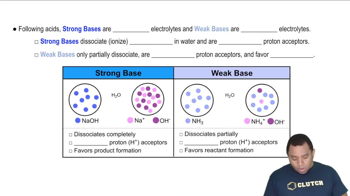
Strong acids and bases completely dissociate in water, while weak acids and bases only partially dissociate. For instance, NaOH is a strong base that fully dissociates, leading to a higher pH, whereas NH4Cl is derived from a weak acid (NH4+) and a strong base (Cl-), resulting in a more acidic solution. This distinction is vital for ranking the acidity of the solutions.
Recommended video:
Guided course
02:22
Strong vs Weak Bases