
The binding of oxygen by hemoglobin in the blood involves the equilibrium reaction: HbH+(aq) + O2(aq) ⇌ HbO2(aq) + H+(aq) In this equation, Hb is hemoglobin. The pH of normal human blood is highly controlled within a range of 7.35 to 7.45. Given the above equilibrium, why is this important? What would happen to the oxygen-carrying capacity of hemoglobin if blood became too acidic (a dangerous condition known as acidosis)?
Ch.17 - Acids and Bases

Chapter 17, Problem 130b,c
Identify the Lewis acid and Lewis base from among the reactants in each equation. b. AlBr3 + NH3 ⇌ H3NAlBr3 c. F–(aq) + BF3(aq) ⇌ BF4–(aq)
Verified step by step guidance1
Identify the reactants in the equation: AlBr3 and NH3.
Recall the definition of a Lewis acid: a species that can accept an electron pair.
Recall the definition of a Lewis base: a species that can donate an electron pair.
Determine which reactant can accept an electron pair: AlBr3, as it has an empty orbital to accept electrons.
Determine which reactant can donate an electron pair: NH3, as it has a lone pair of electrons on the nitrogen atom.

Verified video answer for a similar problem:
This video solution was recommended by our tutors as helpful for the problem above.
Video duration:
55sWas this helpful?
Key Concepts
Here are the essential concepts you must grasp in order to answer the question correctly.
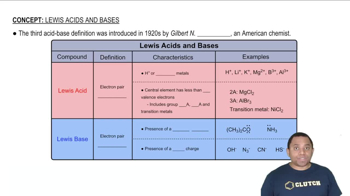
Lewis Acids and Bases
Lewis acids are substances that can accept an electron pair, while Lewis bases are those that can donate an electron pair. This definition expands the concept of acids and bases beyond protons, focusing instead on electron pair interactions. Understanding this distinction is crucial for identifying the roles of reactants in chemical reactions.
Recommended video:
Guided course
Lewis Acids and Bases
Electron Pair Donation
In the context of Lewis theory, electron pair donation refers to the process by which a Lewis base donates a pair of electrons to a Lewis acid. This interaction forms a coordinate covalent bond, where both electrons in the bond originate from the base. Recognizing which reactant donates the electron pair is essential for determining the Lewis base in a reaction.
Recommended video:
Guided course
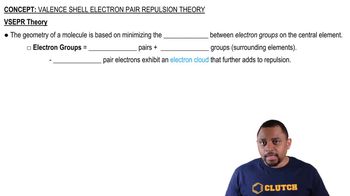
Valence Shell Electron Pair Repulsion Theory
Coordination Complex Formation
Coordination complexes are formed when a Lewis acid and a Lewis base interact, resulting in a new compound where the acid accepts an electron pair from the base. This concept is fundamental in understanding many chemical reactions, particularly in transition metal chemistry, where such complexes play a significant role in reactivity and stability.
Recommended video:
Guided course
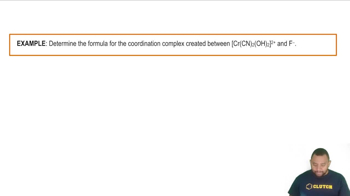
Coordination Complexes Example
Related Practice
Textbook Question
10065
views
1
rank
Textbook Question
Based on these molecular views, determine whether each pictured acid is weak or strong.
705
views
Textbook Question
Based on these molecular views, determine whether each pictured acid is weak or strong.
Textbook Question
Identify the Lewis acid and Lewis base from among the reactants in each equation. a. Ag+(aq) + 2 NH3(aq) ⇌ Ag(NH3)2+(aq)
1113
views
Textbook Question
Identify the Lewis acid and Lewis base from among the reactants in each equation. a. Fe3+(aq) + 6 H2O(l) ⇌ Fe(H2O)63+(aq) b. Zn2+(aq) + 4 NH3(aq) ⇌ Zn(NH3)42+(aq) c. (CH3)3N(g) + BF3(g) ⇌ (CH3)3NBF3(s)
1253
views
Textbook Question
Classify each species as either a Lewis acid or a Lewis base. d. CN–
497
views
