A 25.0-mL sample of 0.125 M pyridine is titrated with 0.100 M HCl. Calculate the pH at each volume of added acid: one-half equivalence.
Ch.18 - Aqueous Ionic Equilibrium

Chapter 18, Problem 80d
A 25.0-mL sample of 0.125 M pyridine is titrated with 0.100 M HCl. Calculate the pH at each volume of added acid: equivalence point.
Verified step by step guidance1
Identify the reaction: Pyridine (C_5H_5N) is a weak base and reacts with HCl, a strong acid, to form pyridinium chloride (C_5H_5NH^+Cl^-).
Calculate the moles of pyridine initially present using the formula: \( \text{moles} = \text{concentration} \times \text{volume} \).
Determine the volume of HCl needed to reach the equivalence point by using the stoichiometry of the reaction, where moles of HCl equal moles of pyridine.
At the equivalence point, all pyridine is converted to pyridinium ion (C_5H_5NH^+). Calculate the concentration of C_5H_5NH^+ in the solution.
Use the hydrolysis of the pyridinium ion to find the pH. Set up the equilibrium expression for the reaction of C_5H_5NH^+ with water and solve for \([H^+]\) to find the pH.
Key Concepts
Here are the essential concepts you must grasp in order to answer the question correctly.
Titration
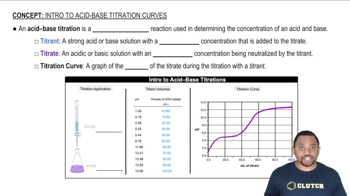
Titration is a quantitative analytical technique used to determine the concentration of a solute in a solution. It involves the gradual addition of a titrant (in this case, HCl) to a solution of the analyte (pyridine) until the reaction reaches its equivalence point, where stoichiometrically equivalent amounts of acid and base have reacted.
Recommended video:
Guided course
Acid-Base Titration
Equivalence Point
The equivalence point in a titration is the stage at which the amount of titrant added is exactly enough to completely neutralize the analyte in the solution. At this point, the moles of acid equal the moles of base, resulting in a solution that may contain the salt formed from the reaction, and the pH can be determined based on the properties of the resulting solution.
Recommended video:
Guided course
At the Equivalence Point
pH Calculation
pH is a measure of the acidity or basicity of a solution, defined as the negative logarithm of the hydrogen ion concentration. At the equivalence point of a titration involving a weak base (like pyridine) and a strong acid (like HCl), the pH can be calculated using the concentration of the resulting salt and its hydrolysis in water, which affects the final pH of the solution.
Recommended video:
Guided course
pH Calculation Example
Related Practice
Textbook Question
453
views
Textbook Question
A 25.0-mL sample of 0.125 M pyridine is titrated with 0.100 M HCl. Calculate the pH at each volume of added acid: 10 mL.
470
views
Textbook Question
Consider the titration of a 25.0-mL sample of 0.175 M CH3NH2 with 0.150 M HBr. Determine each quantity. e. the pH at the equivalence point
588
views
Textbook Question
A 25.0-mL sample of 0.125 M pyridine is titrated with 0.100 M HCl. Calculate the pH at each volume of added acid: 40 mL.
1123
views
Textbook Question
A 25.0-mL sample of 0.125 M pyridine is titrated with 0.100 M HCl. Calculate the pH at each volume of added acid: 50 mL.
332
views
Textbook Question
A 25.0-mL sample of 0.125 M pyridine is titrated with 0.100 M HCl. Calculate the pH at each volume of added acid: 0 mL.
330
views