Calculate the ratio of NaF to HF required to create a buffer with pH = 3.90.

Ch.18 - Aqueous Ionic Equilibrium

Chapter 18, Problem 41a
Calculate the pH of the solution that results from each mixture. a. 50.0 mL of 0.15 M HCHO2 with 75.0 mL of 0.13 M NaCHO2
Verified step by step guidance1
1. Identify the species in the solution. HCHO2 is a weak acid and NaCHO2 is the salt of its conjugate base, CHO2-. This is a buffer solution, so we can use the Henderson-Hasselbalch equation to calculate the pH.
2. Calculate the initial moles of HCHO2 and CHO2- in the solution. This can be done by multiplying the volume (in liters) of each solution by its molarity. Remember that the volume of the solution is the sum of the volumes of the acid and the base.
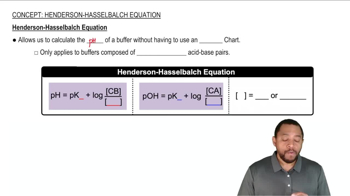
3. Use the Henderson-Hasselbalch equation, pH = pKa + log([A-]/[HA]), where [A-] is the molar concentration of the base (CHO2-) and [HA] is the molar concentration of the acid (HCHO2). The pKa value can be found in a table or given in the problem.
4. Substitute the values of pKa, [A-] and [HA] into the Henderson-Hasselbalch equation to calculate the pH of the solution.
5. If the pH is less than 7, the solution is acidic. If the pH is greater than 7, the solution is basic. If the pH is 7, the solution is neutral.

Verified video answer for a similar problem:
This video solution was recommended by our tutors as helpful for the problem above.
Was this helpful?
Key Concepts
Here are the essential concepts you must grasp in order to answer the question correctly.
Acid-Base Chemistry
Acid-base chemistry involves the study of substances that can donate protons (acids) or accept protons (bases). In this question, HCHO2 (formic acid) acts as the acid, while NaCHO2 (sodium formate) serves as its conjugate base. Understanding the properties of acids and bases, including their dissociation in water, is essential for calculating pH.
Recommended video:
Guided course
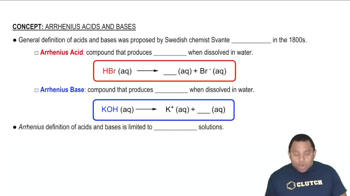
Arrhenius Acids and Bases
Henderson-Hasselbalch Equation
The Henderson-Hasselbalch equation is a formula used to calculate the pH of a buffer solution. It relates the pH to the pKa of the acid and the ratio of the concentrations of the conjugate base to the acid. This equation is particularly useful in this scenario, as the mixture of formic acid and sodium formate creates a buffer system.
Recommended video:
Guided course
Henderson-Hasselbalch Equation
Dilution and Concentration Calculations
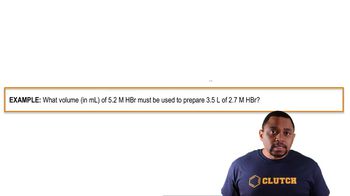
Dilution and concentration calculations are crucial for determining the final concentrations of solutes in a solution after mixing. When two solutions are combined, the total volume changes, affecting the concentrations of the individual components. Accurately calculating the new concentrations of HCHO2 and NaCHO2 after mixing is necessary to apply the Henderson-Hasselbalch equation effectively.
Recommended video:
Guided course
Dilution Calculation Example
Related Practice
Textbook Question
Textbook Question
A buffer contains significant amounts of ammonia and ammonium chloride. Write equations showing how this buffer neutralizes added acid and added base.
1687
views
Textbook Question
Use the Henderson–Hasselbalch equation to calculate the pH of each solution in Problem 29.
Textbook Question
What mass of sodium benzoate should you add to 150.0 mL of a 0.15 M benzoic acid solution to obtain a buffer with a pH of 4.25? (Assume no volume change.)
2294
views
2
rank
1
comments
Textbook Question
Use the Henderson–Hasselbalch equation to calculate the pH of each solution. c. a solution that contains 10.0 g of HC2H3O2 and 10.0 g of NaC2H3O2 in 150.0 mL of solution
3757
views
1
rank
1
comments
Textbook Question
Calculate the pH of the solution that results from each mixture. b. 125.0 mL of 0.10 M NH3 with 250.0 mL of 0.10 M NH4Cl
1295
views