Consider the titration of a 35.0-mL sample of 0.175 M HBr with 0.200 M KOH. Determine each quantity. c. the pH at 10.0 mL of added base
Ch.18 - Aqueous Ionic Equilibrium

Chapter 18, Problem 73b
Consider the titration of a 35.0-mL sample of 0.175 M HBr with 0.200 M KOH. Determine each quantity. b. the volume of added base required to reach the equivalence point
Verified step by step guidance1
Identify the balanced chemical equation for the reaction: \( \text{HBr} + \text{KOH} \rightarrow \text{KBr} + \text{H}_2\text{O} \).
Determine the moles of \( \text{HBr} \) in the initial solution using the formula: \( \text{moles} = \text{concentration} \times \text{volume} \). Convert the volume from mL to L.
Since the reaction is a 1:1 molar ratio, the moles of \( \text{KOH} \) required to reach the equivalence point will be equal to the moles of \( \text{HBr} \).
Calculate the volume of \( \text{KOH} \) solution needed using the formula: \( \text{volume} = \frac{\text{moles of KOH}}{\text{concentration of KOH}} \).
Convert the volume of \( \text{KOH} \) from liters to milliliters for the final answer.

Verified video answer for a similar problem:
This video solution was recommended by our tutors as helpful for the problem above.
Video duration:
2mWas this helpful?
Key Concepts
Here are the essential concepts you must grasp in order to answer the question correctly.
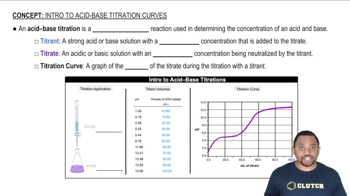
Titration
Titration is a quantitative analytical technique used to determine the concentration of a solute in a solution. It involves the gradual addition of a titrant (a solution of known concentration) to a sample until the reaction reaches its equivalence point, where the amount of titrant added is stoichiometrically equivalent to the amount of substance in the sample.
Recommended video:
Guided course
Acid-Base Titration
Equivalence Point
The equivalence point in a titration is the stage at which the amount of titrant added is exactly enough to completely neutralize the analyte in the solution. At this point, the moles of acid equal the moles of base, and it is often indicated by a color change in an appropriate indicator or by measuring pH.
Recommended video:
Guided course
At the Equivalence Point
Stoichiometry
Stoichiometry is the calculation of reactants and products in chemical reactions based on the balanced chemical equation. It allows for the determination of the relationships between the quantities of substances involved, which is essential for calculating the volume of titrant needed to reach the equivalence point in a titration.
Recommended video:
Guided course
Stoichiometry Concept
Related Practice
Textbook Question
1826
views
1
rank
Textbook Question
Consider the titration of a 35.0-mL sample of 0.175 M HBr with 0.200 M KOH. Determine each quantity. e. the pH after adding 5.0 mL of base beyond the equivalence point
2413
views
2
rank
Textbook Question
Consider the titration of a 35.0-mL sample of 0.175 M HBr with 0.200 M KOH. Determine each quantity. a. the initial pH
3592
views
4
rank
Textbook Question
Consider the curve shown here for the titration of a weak base with a strong acid and answer each question.
c. At what volume of added acid does pH = 14 - pKb?
827
views
Textbook Question
Consider the curve shown here for the titration of a weak base with a strong acid and answer each question.
d. At what volume of added acid is the pH calculated by working an equilibrium problem based on the concentration and Ka of the conjugate acid?
1656
views