A solution is made 1.1⨉10-3 M in Zn(NO3)2 and 0.150 M in NH3. After the solution reaches equilibrium, what concentration of Zn2+(aq) remains?
Ch.18 - Aqueous Ionic Equilibrium

Chapter 18, Problem 111
What is the minimum concentration of KOH required for precipitation to begin for each of the following cation solutions? a. 0.015 M CaCl2 b. 0.0025 M Fe(NO3)2 c. 0.0018 M MgBr2
Verified step by step guidance1
Identify the relevant solubility product constant (K_sp) for each cation's hydroxide compound: Ca(OH)_2, Fe(OH)_2, and Mg(OH)_2.
Write the balanced chemical equation for the precipitation reaction of each cation with OH^- ions: Ca^{2+} + 2OH^- \(\rightarrow\) Ca(OH)_2, Fe^{2+} + 2OH^- \(\rightarrow\) Fe(OH)_2, Mg^{2+} + 2OH^- \(\rightarrow\) Mg(OH)_2.
Express the K_sp expression for each hydroxide: K_{sp} = [Ca^{2+}][OH^-]^2, K_{sp} = [Fe^{2+}][OH^-]^2, K_{sp} = [Mg^{2+}][OH^-]^2.
Substitute the given concentration of each cation into the K_sp expression to solve for the minimum [OH^-] required for precipitation: [OH^-] = \(\sqrt{\frac{K_{sp}\)}{[Ca^{2+}]}}, [OH^-] = \(\sqrt{\frac{K_{sp}\)}{[Fe^{2+}]}}, [OH^-] = \(\sqrt{\frac{K_{sp}\)}{[Mg^{2+}]}}, where [Ca^{2+}], [Fe^{2+}], and [Mg^{2+}] are the given concentrations.
Calculate the minimum concentration of KOH required, which is equal to the [OH^-] concentration found in the previous step, since KOH dissociates completely in solution.
Key Concepts
Here are the essential concepts you must grasp in order to answer the question correctly.
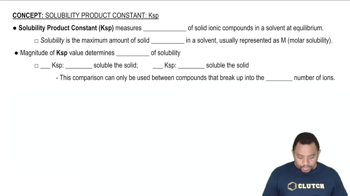
Solubility Product Constant (Ksp)
The solubility product constant (Ksp) is an equilibrium constant that applies to the solubility of ionic compounds. It represents the maximum concentration of ions in a saturated solution at a given temperature. For precipitation to occur, the product of the ion concentrations must exceed the Ksp value of the compound being formed, indicating that the solution is supersaturated.
Recommended video:
Guided course
Solubility Product Constant
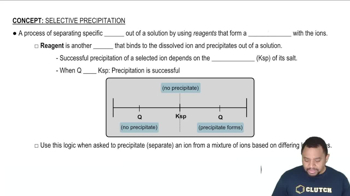
Precipitation Reaction
A precipitation reaction occurs when two soluble salts react in solution to form an insoluble compound, or precipitate. This process is driven by the formation of a solid that separates from the liquid phase. In the context of the question, KOH reacts with cations from the given solutions to form insoluble hydroxides, leading to precipitation.
Recommended video:
Guided course
Selective Precipitation
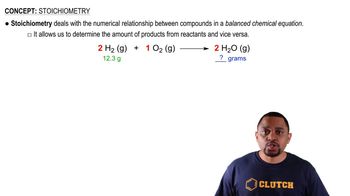
Ion Concentration and Stoichiometry
Ion concentration refers to the amount of a specific ion present in a solution, typically expressed in molarity (M). Stoichiometry involves the quantitative relationships between reactants and products in a chemical reaction. To determine the minimum concentration of KOH needed for precipitation, one must consider the stoichiometric ratios of KOH to the cations in the solutions and their respective solubility limits.
Recommended video:
Guided course
Stoichiometry Concept
Related Practice
Textbook Question
1060
views
Textbook Question
Determine the minimum concentration of the precipitating agent on the right to cause precipitation of the cation from the solution on the left. b. 0.085 M CaI2; K2SO4
561
views
Textbook Question
Predict whether a precipitate will form if you mix 75.0 mL of a NaOH solution with pOH = 2.58 with 125.0 mL of a 0.018 M MgCl2 solution. Identify the precipitate, if any.
1277
views
Textbook Question
A solution containing sodium fluoride is mixed with one containing calcium nitrate to form a solution that is 0.015 M in NaF and 0.010 M in Ca(NO3)2. Does a precipitate form in the mixed solution? If so, identify the precipitate.
1711
views
Textbook Question
A solution is 0.010 M in Ba2+ and 0.020 M in Ca2+. b. What is the remaining concentration of the cation that precipitates first, when the other cation begins to precipitate?
1213
views