Ch.19 - Free Energy & Thermodynamics
Tro - Chemistry: A Molecular Approach 6th Edition
Tro6th EditionChemistry: A Molecular ApproachISBN: 9780137832217Not the one you use?Change textbook
Chapter 19, Problem 76

Consider the reaction: CO2(g) + CCl4(g) ⇌ 2 COCl2(g) Calculate ΔG for this reaction at 25 °C under the following conditions: i. PCO2 = 0.112 atm ii. PCCl4 = 0.174 atm iii. PCOCl2 = 0.744 atm

Verified step by step guidance
1
Identify the reaction: CO_2(g) + CCl_4(g) ⇌ 2 COCl_2(g).
Use the formula for the reaction quotient, Q: Q = \(\frac{{(P_{COCl_2}\))^2}}{{P_{CO_2} \(\cdot\) P_{CCl_4}}}.
Substitute the given partial pressures into the expression for Q: P_{CO_2} = 0.112 \(\text{ atm}\), P_{CCl_4} = 0.174 \(\text{ atm}\), P_{COCl_2} = 0.744 \(\text{ atm}\).
Calculate the standard Gibbs free energy change, \(\Delta\) G^\(\circ\), using the equation \(\Delta\) G = \(\Delta\) G^\(\circ\) + RT \(\ln\) Q, where R = 8.314 \(\text{ J/mol·K}\) and T = 298 \(\text{ K}\).
Determine \(\Delta\) G by substituting the calculated Q and known values into the equation.

Key Concepts

Here are the essential concepts you must grasp in order to answer the question correctly.

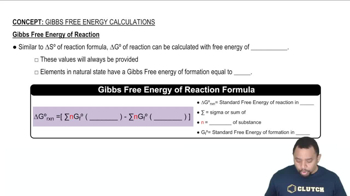
Gibbs Free Energy (ΔG)

Gibbs Free Energy (ΔG) is a thermodynamic potential that measures the maximum reversible work obtainable from a thermodynamic system at constant temperature and pressure. It is a crucial concept in predicting the spontaneity of a reaction; a negative ΔG indicates that a reaction can occur spontaneously, while a positive ΔG suggests non-spontaneity. The relationship between ΔG, enthalpy, and entropy is given by the equation ΔG = ΔH - TΔS.
Recommended video:
Guided course
01:51
Gibbs Free Energy of Reactions

Equilibrium Constant (K)

The equilibrium constant (K) is a dimensionless value that expresses the ratio of the concentrations of products to reactants at equilibrium for a given reaction at a specific temperature. For the reaction CO2(g) + CCl4(g) ⇌ 2 COCl2(g), K can be calculated using the partial pressures of the gases involved. Understanding K is essential for calculating ΔG, as the relationship ΔG = ΔG° + RT ln(Q) connects the standard Gibbs free energy change (ΔG°) to the reaction quotient (Q) and K.
Recommended video:
Guided course
01:14
Equilibrium Constant K

Reaction Quotient (Q)

The reaction quotient (Q) is a measure of the relative amounts of products and reactants present in a reaction at any point in time, calculated using the same expression as the equilibrium constant (K). It helps determine the direction in which a reaction will proceed to reach equilibrium. If Q < K, the reaction will shift to the right (toward products), while if Q > K, it will shift to the left (toward reactants). In this question, Q is calculated using the given partial pressures.
Recommended video:
Guided course
00:49
Reaction Quotient Q