Consider the evaporation of methanol at 25.0 °C : CH3OH(l) → CH3OH(g) b. Find ΔGr at 25.0 °C under the following nonstandard conditions: i. PCH3OH = 150.0 mmHg ii. PCH3OH = 100.0 mmHg iii. PCH3OH = 10.0 mmHg
Ch.19 - Free Energy & Thermodynamics

Chapter 19, Problem 73c
Consider the sublimation of iodine at 25.0 °C : I2(s) → I2(g) c. Explain why iodine spontaneously sublimes in open air at 25.0 °C
Verified step by step guidance1
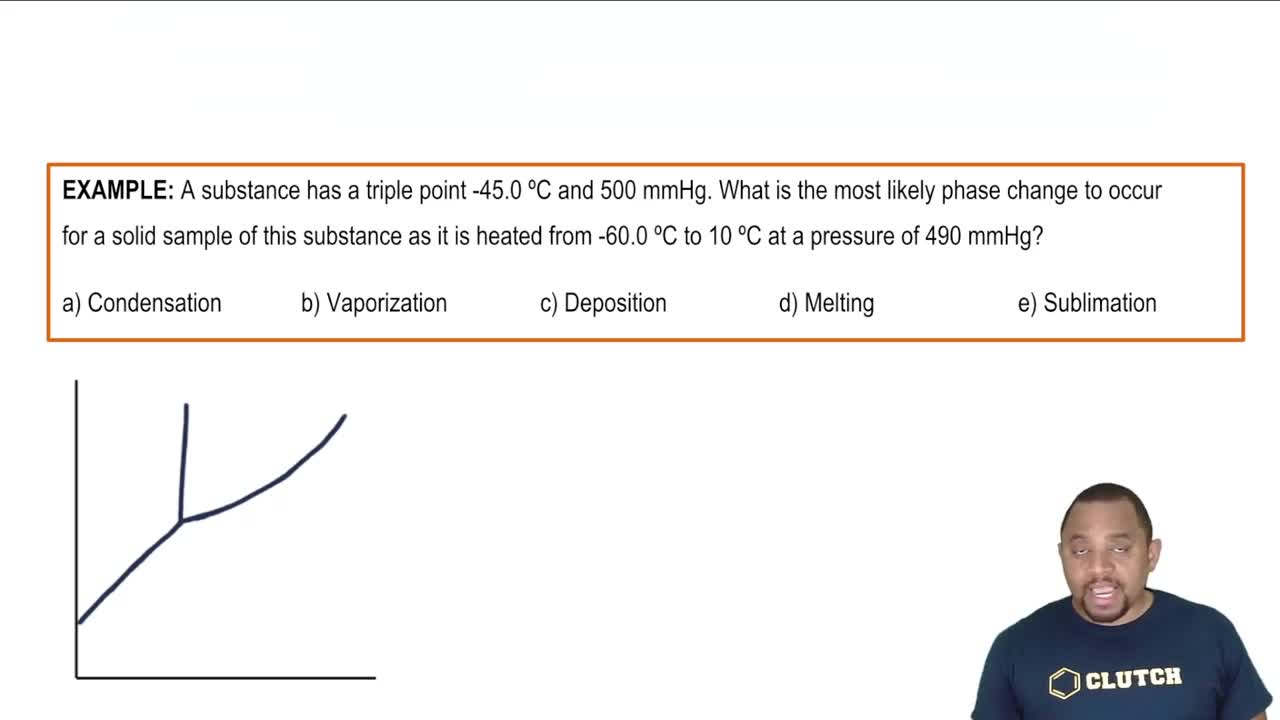
1. Sublimation is the process by which a substance changes from a solid to a gas without passing through the liquid phase. For iodine, this process can occur at room temperature (25.0 °C).
2. The spontaneity of a process is determined by the change in Gibbs free energy (ΔG). If ΔG is negative, the process is spontaneous. The Gibbs free energy is given by the equation ΔG = ΔH - TΔS, where ΔH is the change in enthalpy, T is the temperature in Kelvin, and ΔS is the change in entropy.
3. In the case of iodine sublimation, the process is endothermic (ΔH > 0) because energy is absorbed to break the intermolecular forces holding the iodine molecules together in the solid phase. However, the process leads to a significant increase in entropy (ΔS > 0) because gas particles are much more disordered than solid particles.
4. At room temperature, the TΔS term in the Gibbs free energy equation is large enough to make ΔG negative, despite the positive ΔH. This is because the increase in disorder (entropy) is a dominant factor at this temperature.
5. Therefore, iodine spontaneously sublimes in open air at 25.0 °C because the process results in a decrease in Gibbs free energy, primarily due to the significant increase in entropy when iodine changes from a solid to a gas.

Verified video answer for a similar problem:
This video solution was recommended by our tutors as helpful for the problem above.
Video duration:
1mWas this helpful?
Key Concepts
Here are the essential concepts you must grasp in order to answer the question correctly.
Sublimation
Sublimation is the phase transition in which a substance changes directly from a solid to a gas without passing through the liquid phase. This process occurs when the molecules in the solid gain enough energy to overcome intermolecular forces and escape into the gas phase. For iodine, sublimation is favored at certain temperatures and pressures, particularly when the solid is exposed to open air.
Recommended video:
Guided course
Sublimation Phase Change Example
Vapor Pressure
Vapor pressure is the pressure exerted by a vapor in equilibrium with its solid or liquid phase at a given temperature. For iodine, at 25.0 °C, the vapor pressure is significant enough to allow iodine molecules to escape from the solid phase into the gas phase. When the vapor pressure exceeds the atmospheric pressure, sublimation occurs spontaneously, leading to the transition of solid iodine to gaseous iodine.
Recommended video:
Guided course
Raoult's Law and Vapor Pressure
Thermodynamics and Spontaneity
Thermodynamics helps determine whether a process is spontaneous based on changes in enthalpy and entropy. For iodine subliming at 25.0 °C, the process is driven by an increase in entropy, as gas molecules have greater disorder than solid molecules. The Gibbs free energy change (ΔG) for sublimation is negative under these conditions, indicating that the process occurs spontaneously in open air.
Related Practice
Textbook Question
2431
views
Textbook Question
Consider the evaporation of methanol at 25.0 °C : CH3OH(l) → CH3OH(g) a. Find ΔG°r at 25.0 °C.
2543
views
Textbook Question
Consider the evaporation of methanol at 25.0 °C : CH3OH(l) → CH3OH(g) c. Explain why methanol spontaneously evaporates in open air at 25.0 °C
617
views
Textbook Question
Consider the sublimation of iodine at 25.0 °C : I2(s) → I2(g) b. Find ΔG°rxn at 25.0 °C under the following nonstandard conditions: i. PI2 = 1.00 mmHg ii. PI2 = 0.100 mmHg
2930
views
2
rank
Textbook Question
Determine ΔG° for the reaction: Fe2O3(s) + 3 CO(g) → 2 Fe(s) + 3 CO2(g) Use the following reactions with known ΔG°rxn values:
2 Fe(s) + 3/2 O2(g) → Fe2O3(s) ΔG°rxn = -742.2 kJ
CO(g) + 12 O2( g) → CO2(g) ΔG°rxn = -257.2 kJ
3009
views
2
rank