
Textbook Question
How does the molar entropy of a substance change with increasing temperature?
889
views
 Verified step by step guidance
 01:51
01:51
 02:30
02:30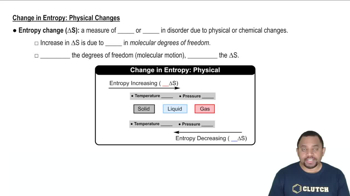 02:35
02:35How does the molar entropy of a substance change with increasing temperature?
Given the values of ΔH°rxn, ΔS°rxn, and T, determine ΔSuniv and predict whether or not each reaction is spontaneous. (Assume that all reactants and products are in their standard states.) c. ΔH°rxn = +75 kJ; ΔS°rxn = -127 J/K; T = 298 K
For each pair of substances, choose the one that you expect to have the higher standard molar entropy (S°) at 25 °C. Explain your choices. a. CO(g); CO2(g) b. CH3OH(l); CH3OH(g) c. Ar(g); CO2(g) d. CH4(g); SiH4(g) e. NO2(g); CH3CH2CH3(g) f. NaBr(s); NaBr(aq)
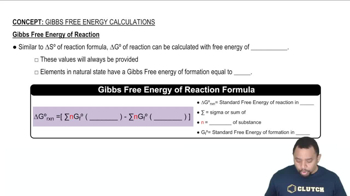
Calculate the change in Gibbs free energy for each of the sets of ΔH°rxn, ΔS°rxn, and T given in Problem 44. Predict whether or not each reaction is spontaneous at the temperature indicated. (Assume that all reactants and products are in their standard states.)
Rank each set of substances in order of increasing standard molar entropy (S°). Explain your reasoning. a. NH3(g); Ne(g); SO2(g); CH3CH2OH(g); He(g) c. CH4(g); CF4(g); CCl4(g)
Calculate the free energy change for this reaction at 25 °C. Is the reaction spontaneous? (Assume that all reactants and products are in their standard states.) 2 Ca(s) + O2( g) → 2 CaO(s) ΔH°rxn = -1269.8 kJ; ΔS°rxn = -364.6 J/K