Use data from Appendix IIB to calculate ΔS°rxn for each of the reactions. In each case, try to rationalize the sign of ΔS°rxn. d. 2 H2S(g) + 3 O2(g) → 2 H2O(l) + 2 SO2(g)
Ch.19 - Free Energy & Thermodynamics

Chapter 19, Problem 58b
Use data from Appendix IIB to calculate ΔS°rxn for each of the reactions. In each case, try to rationalize the sign of ΔS°rxn. b. Cr2O3(s) + 3 CO(g) → 2 Cr(s) + 3 CO2(g)
Verified step by step guidance1
Identify the standard entropy values (S°) for each reactant and product from Appendix IIB.
Write the balanced chemical equation: Cr2O3(s) + 3 CO(g) → 2 Cr(s) + 3 CO2(g).
Calculate the total standard entropy of the reactants: S°(reactants) = S°(Cr2O3) + 3 * S°(CO).
Calculate the total standard entropy of the products: S°(products) = 2 * S°(Cr) + 3 * S°(CO2).
Determine the change in standard entropy for the reaction: ΔS°rxn = S°(products) - S°(reactants).

Verified video answer for a similar problem:
This video solution was recommended by our tutors as helpful for the problem above.
Video duration:
2mWas this helpful?
Key Concepts
Here are the essential concepts you must grasp in order to answer the question correctly.
Standard Entropy (ΔS°)
Standard entropy (ΔS°) is a measure of the disorder or randomness in a system at standard conditions (1 bar, 25°C). It quantifies the amount of energy that is unavailable to do work due to the dispersal of energy among the available microstates of a system. Higher entropy values indicate greater disorder, while lower values suggest more order.
Entropy Change in Reactions
The change in entropy (ΔS°rxn) for a chemical reaction is calculated by subtracting the total standard entropies of the reactants from those of the products. A positive ΔS°rxn indicates an increase in disorder, often associated with the production of gas from solids or liquids, while a negative ΔS°rxn suggests a decrease in disorder, typically when gases are converted to solids or liquids.
Recommended video:
Guided course
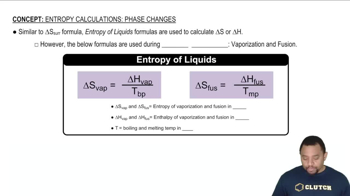
Entropy in Phase Changes
Rationalizing the Sign of ΔS°rxn
Rationalizing the sign of ΔS°rxn involves analyzing the physical states and the number of moles of reactants and products. For example, in the reaction given, the conversion of solid Cr2O3 and gaseous CO to solid Cr and gaseous CO2 results in a net increase in the number of gas molecules, which typically leads to a positive ΔS°rxn, indicating increased disorder in the system.
Recommended video:
Guided course
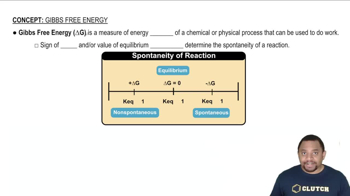
Spontaneity of Reactions
Related Practice
Textbook Question
348
views
Textbook Question
Methanol (CH3OH) burns in oxygen to form carbon dioxide and water. Write a balanced equation for the combustion of liquid methanol and calculate ΔH°rxn, ΔS°rxn, and ΔG°rxn at 25 °C. Is the combustion of methanol spontaneous?
7361
views
2
rank
Textbook Question
Find ΔS° for the formation of CH2Cl2(g) from its gaseous elements in their standard states. Rationalize the sign of ΔS°.
1957
views
1
comments
Textbook Question
Use data from Appendix IIB to calculate ΔS°rxn for each of the reactions. In each case, try to rationalize the sign of ΔS°rxn . b. C(s) + H2O(g) → CO(g) + H2(g)
2217
views
1
rank
Textbook Question
Use data from Appendix IIB to calculate ΔS°rxn for each of the reactions. In each case, try to rationalize the sign of ΔS°rxn. d. N2O4(g) + 4 H2(g) → N2(g) + 4 H2O(g)
340
views