
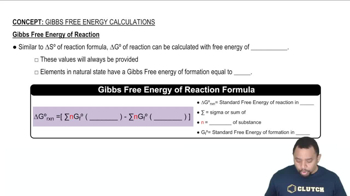
Use standard free energies of formation to calculate ΔG° at 25 °C for each reaction in Problem 61. How do the values of ΔG° calculated this way compare to those calculated from ΔH° and ΔS°? Which of the two methods could be used to determine how ΔG° changes with temperature?

Using standard free energies of formation, calculate ΔG° at 25 °C for each reaction in Problem 62. How do the values of ΔG° calculated this way compare to those calculated from ΔH° and ΔS°? Which of the two methods can determine how ΔG° changes with temperature?
Verified step by step guidanceKey Concepts
Gibbs Free Energy (ΔG°)
Standard Free Energies of Formation
Temperature Dependence of ΔG°
For each reaction, calculate ΔH°rxn, ΔS°rxn, and ΔG°rxn at 25 °C and state whether or not the reaction is spontaneous. If the reaction is not spontaneous, would a change in temperature make it spontaneous? If so, should the temperature be raised or lowered from 25 °C? c. N2(g) + O2(g) → 2 NO(g)
For each reaction, calculate ΔH°rxn, ΔS°rxn, and ΔG°rxn at 25 °C and state whether or not the reaction is spontaneous. If the reaction is not spontaneous, would a change in temperature make it spontaneous? If so, should the temperature be raised or lowered from 25 °C? d. 2 KClO3(s) → 2 KCl(s) + 3 O2(g)
Determine ΔG° for the reaction: Fe2O3(s) + 3 CO(g) → 2 Fe(s) + 3 CO2(g) Use the following reactions with known ΔG°rxn values:
2 Fe(s) + 3/2 O2(g) → Fe2O3(s) ΔG°rxn = -742.2 kJ
CO(g) + 12 O2( g) → CO2(g) ΔG°rxn = -257.2 kJ
