
Textbook Question
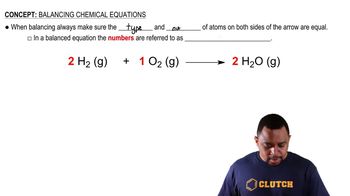
Determine whether or not each metal dissolves in 1 M HNO3. For those metals that do dissolve, write a balanced redox reaction showing what happens when the metal dissolves. a. Ag

 Verified step by step guidance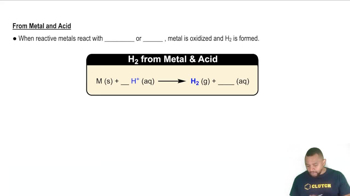
 00:52
00:52
 01:32
01:32Determine whether or not each metal dissolves in 1 M HNO3. For those metals that do dissolve, write a balanced redox reaction showing what happens when the metal dissolves. a. Ag
Determine whether or not each redox reaction occurs spontaneously in the forward direction.
a. Ca2+(aq) + Zn(s) → Ca(s) + Zn2+(aq)
b. 2 Ag+(aq) + Ni(s) → 2 Ag(s) + Ni2+(aq)
c. Fe(s) + Mn2+(aq) → Fe2+(aq) + Mn(s)
d. 2 Al(s) + 3 Pb2+(aq) → 2 Al3+(aq) + 3 Pb(s)
Which metal could you use to reduce Zn2+ ions but not Al3+ ions?
Which metal can be oxidized with an Mn2+ solution but not with an Mg2+ solution?
Calculate E°cell for each balanced redox reaction and determine if the reaction is spontaneous as written. b. MnO2(aq) + 4 H+(aq) + Zn(s) → Mn2+(aq) + 2H2O(l) + Zn2+(aq) c. Cl2(g) + 2 F–(aq) → F2(g) + 2 Cl–(aq)
Calculate E°cell for each balanced redox reaction and determine if the reaction is spontaneous as written. a. 2 Cu(s) + Mn2+(aq) → 2 Cu+(aq) + Mn(s)