Ch.20 - Electrochemistry
Tro - Chemistry: A Molecular Approach 6th Edition
Tro6th EditionChemistry: A Molecular ApproachISBN: 9780137832217Not the one you use?Change textbook
Chapter 20, Problem 79

An electrochemical cell is based on these two half-reactions:
Ox: Pb(s) → Pb2+(aq, 0.10 M) + 2 e
Red: MnO4(aq, 1.50 M) + 4 H+(aq, 2.0 M) + 3 e → MnO2(s) + 2 H2O(l)
Calculate the cell potential at 25 °C.

Verified step by step guidance
1
Identify the oxidation and reduction half-reactions. In this problem, the oxidation half-reaction is given as Pb(s) -> Pb2+ (aq) + 2 e-, and the reduction half-reaction is MnO4-(aq) + 4 H+(aq) + 3 e- -> MnO2(s) + 2 H2O(l).
Balance the number of electrons transferred in each half-reaction to combine them into a full reaction. Since the oxidation reaction produces 2 electrons and the reduction reaction consumes 3 electrons, find the least common multiple (6 electrons) and multiply the first reaction by 3 and the second reaction by 2.
Calculate the standard electrode potentials for each half-reaction if not given. Use standard reduction potential tables to find the values for Pb2+/Pb and MnO4-/MnO2 in their respective conditions.
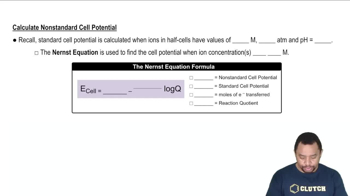
Use the Nernst equation to calculate the cell potential under non-standard conditions. The Nernst equation is E = E° - (RT/nF) * ln(Q), where E° is the standard cell potential, R is the gas constant, T is the temperature in Kelvin, n is the number of moles of electrons transferred, F is the Faraday constant, and Q is the reaction quotient.
Calculate the reaction quotient Q from the given concentrations of the reactants and products. For the reaction quotient, use the formula Q = ([products]^stoichiometric coefficients) / ([reactants]^stoichiometric coefficients), considering the concentrations given in the problem.

Key Concepts

Here are the essential concepts you must grasp in order to answer the question correctly.

Electrochemical Cells

Electrochemical cells consist of two half-cells where oxidation and reduction reactions occur. The oxidation half-cell involves the loss of electrons, while the reduction half-cell involves the gain of electrons. The cell potential, or electromotive force (EMF), is generated due to the difference in potential energy between the two half-reactions, driving the flow of electrons through an external circuit.

Nernst Equation

The Nernst equation relates the cell potential to the concentrations of the reactants and products involved in the half-reactions. It is expressed as E = E° - (RT/nF) ln(Q), where E° is the standard cell potential, R is the gas constant, T is the temperature in Kelvin, n is the number of moles of electrons transferred, F is Faraday's constant, and Q is the reaction quotient. This equation allows for the calculation of the cell potential under non-standard conditions.
Recommended video:
Guided course
01:17
The Nernst Equation

Standard Reduction Potentials

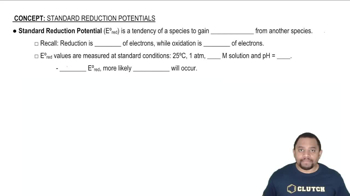
Standard reduction potentials (E°) are measured under standard conditions (1 M concentration, 1 atm pressure, and 25 °C) and indicate the tendency of a species to gain electrons. Each half-reaction has a specific E° value, which can be found in tables. The overall cell potential can be calculated by subtracting the standard reduction potential of the oxidation half-reaction from that of the reduction half-reaction, providing insight into the spontaneity of the electrochemical reaction.
Recommended video:
Guided course
01:10
Standard Reduction Potentials