Balance each redox reaction occurring in basic aqueous solution. c. NO2–(aq) + Al(s) → NH3(g) + AlO2–(aq)
Ch.20 - Electrochemistry

Chapter 20, Problem 56
Is the question formulating correctly? If yes, return the question without changes. If not, please fix it and return the output as a JSON of the form: {'question': 'question text'}. Here is the question: Make a sketch of the voltaic cell represented by the line notation. Write the overall balanced equation for the reaction and calculate E°cell. Mn(s) | Mn2+(aq) || ClO2-(aq) | ClO2(g) | Pt(s)
Verified step by step guidance1
Step 1: Identify the components of the voltaic cell from the line notation. The notation 'Mn(s) | Mn^{2+}(aq) || ClO_2^-(aq) | ClO_2(g) | Pt(s)' indicates that manganese is the anode and the chlorine dioxide is the cathode.
Step 2: Write the half-reactions for the anode and cathode. For the anode, the oxidation reaction is Mn(s) → Mn^{2+}(aq) + 2e^-. For the cathode, the reduction reaction is ClO_2(g) + e^- → ClO_2^-(aq).
Step 3: Balance the electrons in the half-reactions. Multiply the cathode half-reaction by 2 to balance the electrons: 2(ClO_2(g) + e^- → ClO_2^-(aq)).
Step 4: Combine the balanced half-reactions to write the overall balanced equation for the cell reaction. Add the balanced half-reactions together, ensuring that the electrons cancel out.
Step 5: Calculate the standard cell potential, E°_{cell}, using standard reduction potentials from a table. Use the formula E°_{cell} = E°_{cathode} - E°_{anode} to find the cell potential.
Key Concepts
Here are the essential concepts you must grasp in order to answer the question correctly.
Voltaic Cell and Line Notation
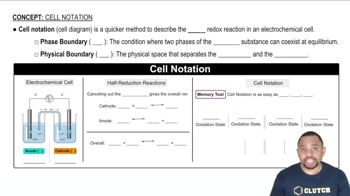
A voltaic cell, or galvanic cell, is an electrochemical cell that converts chemical energy into electrical energy through spontaneous redox reactions. Line notation is a shorthand representation of the cell's components, indicating the anode and cathode, along with the phases of the reactants and products. Understanding how to interpret and draw the voltaic cell from line notation is essential for visualizing the electrochemical processes involved.
Recommended video:
Guided course
Cell Notation
Balanced Chemical Equation
A balanced chemical equation represents a chemical reaction with equal numbers of each type of atom on both sides of the equation. Balancing ensures the law of conservation of mass is upheld, meaning that matter is neither created nor destroyed in the reaction. For voltaic cells, writing the balanced equation is crucial for understanding the stoichiometry of the reactants and products involved in the electrochemical process.
Recommended video:
Guided course
Balancing Chemical Equations
Standard Electrode Potential (E°cell)
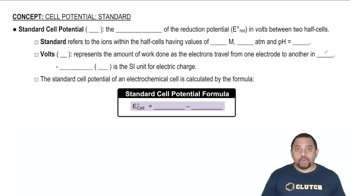
The standard electrode potential (E°cell) is a measure of the driving force behind an electrochemical reaction under standard conditions. It is calculated from the standard reduction potentials of the half-reactions involved in the voltaic cell. A positive E°cell indicates a spontaneous reaction, while a negative value suggests non-spontaneity. Calculating E°cell is vital for predicting the feasibility and direction of the electrochemical reaction.
Recommended video:
Guided course
Standard Cell Potential
Related Practice
Textbook Question
1403
views
Textbook Question
Consider the voltaic cell:
d. Indicate the direction of anion and cation flow in the salt bridge
867
views
Textbook Question
Determine whether or not each redox reaction occurs spontaneously in the forward direction.
a. Ca2+(aq) + Zn(s) → Ca(s) + Zn2+(aq)
b. 2 Ag+(aq) + Ni(s) → 2 Ag(s) + Ni2+(aq)
c. Fe(s) + Mn2+(aq) → Fe2+(aq) + Mn(s)
d. 2 Al(s) + 3 Pb2+(aq) → 2 Al3+(aq) + 3 Pb(s)
1590
views
Textbook Question
Which metal could you use to reduce Zn2+ ions but not Al3+ ions?
Textbook Question
Determine whether or not each redox reaction occurs spontaneously in the forward direction.
a. Ni(s) + Zn2+(aq) → Ni2+(aq) + Zn(s)
b. Ni(s) + Pb2+(aq) → Ni2+(aq) + Pb(s)
c. Al(s) + 3 Ag+(aq) → Al3+(aq) + 3 Ag(s)
d. Pb(s) + Mn2+(aq) → Pb2+(aq) + Mn(s)
1454
views
Textbook Question
Use line notation to represent each electrochemical cell in Problem 43.
945
views