
Textbook Question
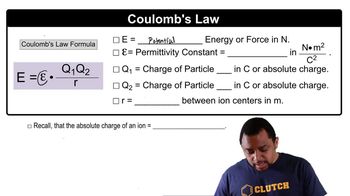
How many electrons are necessary to produce a charge of -11.0 C? What is the mass of this many electrons?
2
views

 Verified step by step guidance
 01:15
01:15
 01:53
01:53How many electrons are necessary to produce a charge of -11.0 C? What is the mass of this many electrons?
Which statements about subatomic particles are true? a. If an atom has an equal number of protons and electrons, it will be charge-neutral. b. Electrons are attracted to protons. c. Electrons are much lighter than neutrons. d. Protons have twice the mass of neutrons.
Which statements are inconsistent with Rutherford's nuclear theory as it was originally stated? Why? a. Since electrons are smaller than protons, and since a hydrogen atom contains only one proton and one electron, it must follow that the volume of a hydrogen atom is mostly due to the proton. b. A nitrogen atom has 7 protons in its nucleus and 7 electrons outside of its nucleus. c. A phosphorus atom has 15 protons in its nucleus and 150 electrons outside of its nucleus. d. The majority of the mass of a fluorine atom is due to its 9 electrons.
On a dry day, your body can accumulate static charge from walking across a carpet or from brushing your hair. If your body develops a charge of -22 µC (microcoulombs), how many excess electrons has it acquired?
Which statements are inconsistent with Dalton's atomic theory as it was originally stated? Why? a. All carbon atoms are identical. b. An oxygen atom combines with 1.5 hydrogen atoms to form a water molecule. c. Two oxygen atoms combine with a carbon atom to form a carbon dioxide molecule. d. The formation of a compound often involves the destruction of one or more atoms.
Which statements about subatomic particles are false? a. Protons and electrons have charges of the same magnitude but opposite sign. b. Protons have about the same mass as neutrons. c. Some atoms don't have any protons. d. Protons and neutrons have charges of the same magnitude but opposite signs.