Ch.21 - Radioactivity & Nuclear Chemistry
Tro - Chemistry: A Molecular Approach 6th Edition
Tro6th EditionChemistry: A Molecular ApproachISBN: 9780137832217Not the one you use?Change textbook
Chapter 21, Problem 77

PET studies require fluorine-18, which is produced in a cyclotron and decays with a half-life of 1.83 hours. Assuming that the F-18 can be transported at 60.0 miles/hour, how close must the hospital be to the cyclotron if 65% of the F-18 produced makes it to the hospital?

Verified step by step guidance
1
insert step 1: Understand the problem by identifying the key information: the half-life of fluorine-18 (1.83 hours), the transportation speed (60.0 miles/hour), and the requirement that 65% of the F-18 must reach the hospital.
insert step 2: Use the concept of half-life to determine the decay constant (k) using the formula: k = \(\frac{0.693}{t_{1/2}\)}, where t_{1/2} is the half-life.
insert step 3: Calculate the time (t) it takes for the F-18 to decay to 65% of its original amount using the first-order decay equation: N_t = N_0 e^{-kt}, where N_t/N_0 = 0.65.
insert step 4: Solve for t in the equation from step 3 to find the time it takes for the F-18 to decay to 65% of its original amount.
insert step 5: Calculate the maximum distance the F-18 can be transported by multiplying the time (t) from step 4 by the transportation speed (60.0 miles/hour).

Key Concepts

Here are the essential concepts you must grasp in order to answer the question correctly.

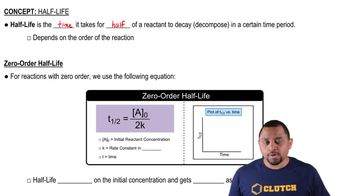
Half-life

Half-life is the time required for half of a sample of a radioactive substance to decay. In this case, fluorine-18 has a half-life of 1.83 hours, meaning that after this time, only 50% of the original amount remains. Understanding half-life is crucial for calculating how much F-18 will be available when it reaches the hospital.
Recommended video:
Guided course
02:17
Zero-Order Half-life

Radioactive decay

Radioactive decay is the process by which an unstable atomic nucleus loses energy by emitting radiation. This process is random and can be quantified using the half-life. For the PET studies, knowing the decay rate of fluorine-18 helps determine how much of the isotope will still be viable upon arrival at the hospital.

Distance and time calculation

Calculating the distance based on speed and time involves using the formula distance = speed × time. In this scenario, the speed of transport is given as 60.0 miles/hour, and the time until a significant amount of F-18 decays must be calculated based on its half-life. This concept is essential for determining how far the hospital can be from the cyclotron while still receiving an effective dose of F-18.
Recommended video:
Guided course
02:16
Electrochemical Stoichiometric Chart (Time)