Identify each organic compound as an alkane, alkene, alkyne, aromatic hydrocarbon, alcohol, ether, aldehyde, ketone, carboxylic acid, ester, or amine, and provide a name for the compound. c.
Ch.22 - Organic Chemistry

Chapter 22, Problem 91a
Identify each organic compound as an alkane, alkene, alkyne, aromatic hydrocarbon, alcohol, ether, aldehyde, ketone, carboxylic acid, ester, or amine, and provide a name for the compound. a.

Verified step by step guidance1
Identify the functional group present in the compound. The structure shows a carbon double-bonded to an oxygen and single-bonded to a hydrogen, which is characteristic of an aldehyde group.
Count the number of carbon atoms in the longest continuous chain that includes the aldehyde group. In this structure, there are five carbon atoms.
Determine the root name based on the number of carbon atoms. For five carbon atoms, the root name is 'pent'.
Since the compound is an aldehyde, the suffix '-al' is used. Combine the root name with the suffix to form the name 'pentanal'.
Verify the structure to ensure there are no other functional groups or branches that need to be considered in the naming process. In this case, the structure is a straight chain with no additional functional groups or branches.

Verified video answer for a similar problem:
This video solution was recommended by our tutors as helpful for the problem above.
Video duration:
1mWas this helpful?
Key Concepts
Here are the essential concepts you must grasp in order to answer the question correctly.
Functional Groups
Functional groups are specific groups of atoms within molecules that are responsible for the characteristic chemical reactions of those molecules. In organic chemistry, the presence of functional groups such as carbonyls, hydroxyls, and carboxyls determines the classification of compounds. For example, the carbonyl group (C=O) is a key feature of aldehydes and ketones.
Aldehydes
Aldehydes are organic compounds that contain a carbonyl group (C=O) bonded to at least one hydrogen atom. They are characterized by the general formula RCHO, where R represents a hydrocarbon chain. Aldehydes are typically found at the end of carbon chains, making them distinct from ketones, which have the carbonyl group located within the chain.
Recommended video:
Guided course
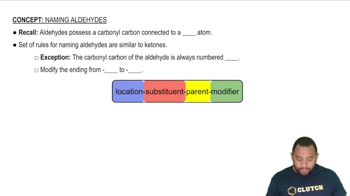
Rules for Naming Aldehydes
Nomenclature of Organic Compounds
The nomenclature of organic compounds follows systematic rules established by the International Union of Pure and Applied Chemistry (IUPAC). This includes identifying the longest carbon chain, determining the functional groups present, and assigning appropriate suffixes and prefixes. For aldehydes, the suffix '-al' is used, indicating the presence of the carbonyl group at the terminal position.
Recommended video:
Guided course
Introduction to Organic Chemistry
Related Practice
Textbook Question
893
views
Textbook Question
List the products of each amine reaction. a.
82
views
Textbook Question
Identify each organic compound as an alkane, alkene, alkyne, aromatic hydrocarbon, alcohol, ether, aldehyde, ketone, carboxylic acid, ester, or amine, and provide a name for the compound. e.
559
views
Textbook Question
List the products of each amine reaction. b.
81
views
Textbook Question
Classify each amine reaction as acid–base or condensation and list its products.
c. CH3NH2 + H2SO4 →
93
views
Textbook Question
Identify each organic compound as an alkane, alkene, alkyne, aromatic hydrocarbon, alcohol, ether, aldehyde, ketone, carboxylic acid, ester, or amine, and provide a name for the compound. a.
1274
views