
Most fertilizers consist of nitrogen-containing compounds such as NH3, CO(NH2)2, NH4NO3, and (NH4)2SO4. Plants use the nitrogen content in these compounds for protein synthesis. Calculate the mass percent composition of nitrogen in CO(NH2)2.
Ch.3 - Molecules and Compounds

Chapter 3, Problem 80a
Calculate the mass percent composition of nitrogen in each nitrogen-containing compound. a. N2O b. NO
Verified step by step guidance1
Step 1: Identify the molar mass of each element in the compound. The molar mass of nitrogen (N) is approximately 14.01 g/mol and the molar mass of oxygen (O) is approximately 16.00 g/mol.
Step 2: Calculate the molar mass of the compound. For N2O, there are two nitrogen atoms and one oxygen atom. So, the molar mass of N2O is (2 * molar mass of N) + (1 * molar mass of O).
Step 3: Calculate the total mass contributed by nitrogen in the compound. This is done by multiplying the number of nitrogen atoms in the compound by the molar mass of nitrogen.
Step 4: Calculate the mass percent composition of nitrogen in the compound. This is done by dividing the total mass contributed by nitrogen (from step 3) by the molar mass of the compound (from step 2) and then multiplying by 100 to get the percentage.
Step 5: The result from step 4 is the mass percent composition of nitrogen in N2O.
Key Concepts
Here are the essential concepts you must grasp in order to answer the question correctly.
Molar Mass
Molar mass is the mass of one mole of a substance, typically expressed in grams per mole (g/mol). It is calculated by summing the atomic masses of all the atoms in a molecule. For example, in the compound N2O, the molar mass is determined by adding the molar masses of two nitrogen atoms and one oxygen atom.
Recommended video:
Guided course
Molar Mass Concept
Mass Percent Composition
Mass percent composition refers to the percentage by mass of each element in a compound. It is calculated using the formula: (mass of the element in the compound / total mass of the compound) x 100%. This concept is essential for understanding the distribution of elements within a compound, such as determining the mass percent of nitrogen in N2O.
Stoichiometry
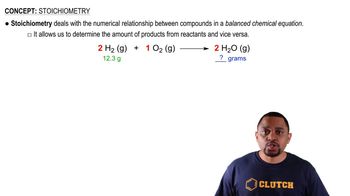
Stoichiometry is the area of chemistry that deals with the relationships between the quantities of reactants and products in chemical reactions. It allows chemists to predict the amounts of substances consumed and produced in a reaction. In the context of calculating mass percent composition, stoichiometry helps in understanding how the proportions of elements relate to the overall mass of the compound.
Recommended video:
Guided course
Stoichiometry Concept
Related Practice
Textbook Question
1368
views
Textbook Question
Iron in the earth is in the form of iron ore. Common ores include Fe2O3 (hematite), Fe3O4 (magnetite), and FeCO3 (siderite). Calculate the mass percent composition of iron for each of these iron ores. Which ore has the highest iron content?
1469
views
Textbook Question
Calculate the mass percent composition of nitrogen in each nitrogen-containing compound. c. NO2
2162
views
1
rank
Textbook Question
Calculate the mass percent composition of carbon in each carbon-containing compound. a. CH4 b. C2H6
1040
views
Textbook Question
Calculate the mass percent composition of carbon in each carbon-containing compound. c. C2H2
441
views
Textbook Question
Calculate the mass percent composition of carbon in each carbon-containing compound. d. C2H5Cl
610
views
