
Ch.4 - Chemical Reactions and Chemical Quantities
Tro - Chemistry: A Molecular Approach 6th Edition
Tro6th EditionChemistry: A Molecular ApproachISBN: 9780137832217Not the one you use?Change textbook
Chapter 4, Problem 67

The combustion of gasoline produces carbon dioxide and water. Assume gasoline to be pure octane (C8H18) and calculate the mass (in kg) of carbon dioxide that is added to the atmosphere per 10.0 kg of octane burned. (Hint: Begin by writing a balanced equation for the combustion reaction.)

Verified step by step guidance
1
Write the balanced chemical equation for the combustion of octane (C8H18). The general form of a combustion reaction is: hydrocarbon + oxygen (O2) ightarrow carbon dioxide (CO2) + water (H2O). For octane, the balanced equation is: 2 C8H18 + 25 O2 ightarrow 16 CO2 + 18 H2O.
Calculate the molar mass of octane (C8H18). Using the atomic masses from the periodic table (C = 12.01 g/mol, H = 1.008 g/mol), the molar mass of C8H18 = (8 \(\times\) 12.01) + (18 \(\times\) 1.008) g/mol.
Determine the moles of octane burned using the mass of octane and its molar mass. Moles of octane = mass of octane / molar mass of octane.
Use the stoichiometry of the balanced equation to find the moles of CO2 produced per mole of octane burned. From the balanced equation, 16 moles of CO2 are produced for every 2 moles of octane.
Calculate the mass of CO2 produced using the moles of CO2 and the molar mass of CO2 (C = 12.01 g/mol, O = 16.00 g/mol, so molar mass of CO2 = 12.01 + (2 \(\times\) 16.00) g/mol). Mass of CO2 = moles of CO2 \(\times\) molar mass of CO2. Convert this mass from grams to kilograms to find the mass of CO2 added to the atmosphere per 10.0 kg of octane burned.

Verified video answer for a similar problem:

This video solution was recommended by our tutors as helpful for the problem above.
Was this helpful?

Key Concepts

Here are the essential concepts you must grasp in order to answer the question correctly.

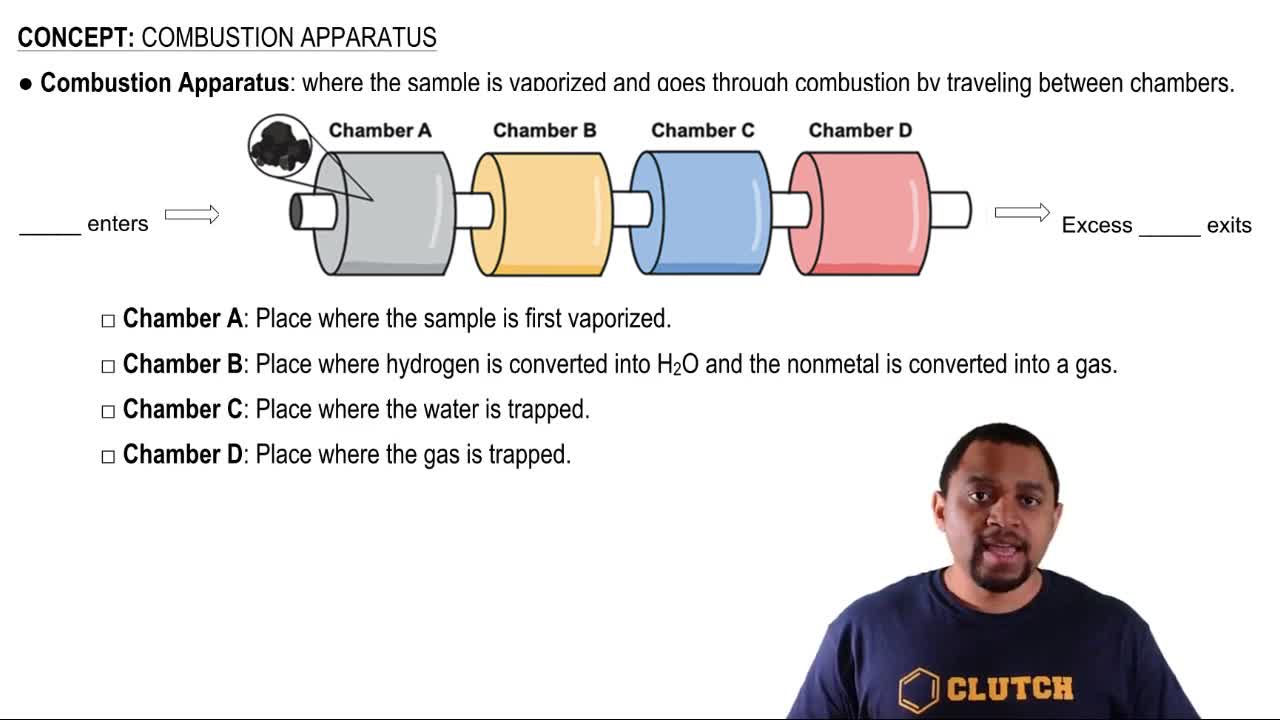
Combustion Reaction

A combustion reaction is a chemical process in which a substance (typically a hydrocarbon) reacts with oxygen to produce carbon dioxide and water. In the case of octane (C8H18), the balanced equation for its combustion is C8H18 + 12.5 O2 → 8 CO2 + 9 H2O. Understanding this reaction is crucial for determining the products and their quantities when octane is burned.
Recommended video:
Guided course
02:24
Combustion Apparatus

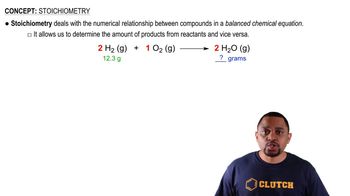
Stoichiometry

Stoichiometry is the calculation of reactants and products in chemical reactions based on the balanced equation. It allows us to determine the relationships between the amounts of substances consumed and produced. In this problem, stoichiometry will be used to find out how much carbon dioxide is produced from burning a specific mass of octane.
Recommended video:
Guided course
01:16
Stoichiometry Concept

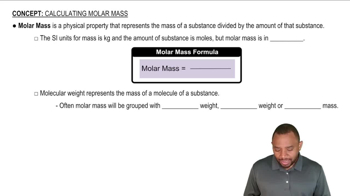
Molar Mass

Molar mass is the mass of one mole of a substance, expressed in grams per mole (g/mol). For octane (C8H18), the molar mass is approximately 114.22 g/mol. Knowing the molar mass is essential for converting between mass and moles, which is necessary for applying stoichiometric calculations in the combustion reaction.
Recommended video:
Guided course
02:11
Molar Mass Concept