
Ch.4 - Chemical Reactions and Chemical Quantities
Tro - Chemistry: A Molecular Approach 6th Edition
Tro6th EditionChemistry: A Molecular ApproachISBN: 9780137832217Not the one you use?Change textbook
Chapter 4, Problem 37

Hydrobromic acid dissolves solid iron according to the reaction:
Fe(s) + 2 HBr(aq) → FeBr2(aq) + H2(g)
What mass of HBr (in g) do you need to dissolve a 2.80-g pure iron bar on a padlock? What mass of H2 would the complete reaction of the iron bar produce?

Verified step by step guidance
1
Identify the balanced chemical equation: \( \text{Fe(s)} + 2 \text{HBr(aq)} \rightarrow \text{FeBr}_2\text{(aq)} + \text{H}_2\text{(g)} \).
Calculate the moles of iron (Fe) using its molar mass: \( \text{Molar mass of Fe} = 55.85 \text{ g/mol} \).
Use the stoichiometry of the reaction to find the moles of HBr needed. According to the balanced equation, 1 mole of Fe reacts with 2 moles of HBr.
Convert the moles of HBr to grams using its molar mass: \( \text{Molar mass of HBr} = 80.91 \text{ g/mol} \).
Calculate the moles of \( \text{H}_2 \) produced using the stoichiometry of the reaction, and then convert it to grams using the molar mass of \( \text{H}_2 \) (2.02 g/mol).

Key Concepts

Here are the essential concepts you must grasp in order to answer the question correctly.

Stoichiometry

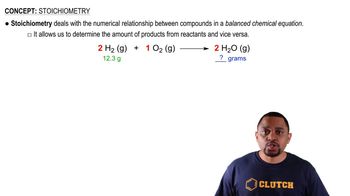
Stoichiometry is the branch of chemistry that deals with the quantitative relationships between the reactants and products in a chemical reaction. It allows us to calculate the amounts of substances consumed and produced in a reaction based on balanced chemical equations. In this case, stoichiometry will help determine how much HBr is needed to react with a given mass of iron and how much hydrogen gas is produced.
Recommended video:
Guided course
01:16
Stoichiometry Concept

Molar Mass

Molar mass is the mass of one mole of a substance, typically expressed in grams per mole (g/mol). It is essential for converting between the mass of a substance and the number of moles, which is crucial in stoichiometric calculations. For this problem, knowing the molar masses of iron (Fe) and hydrobromic acid (HBr) will allow us to find the required mass of HBr and the mass of hydrogen gas produced.
Recommended video:
Guided course
02:11
Molar Mass Concept

Balancing Chemical Equations

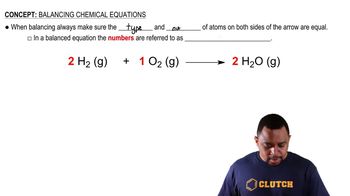
Balancing chemical equations is the process of ensuring that the number of atoms for each element is the same on both sides of the equation. This reflects the law of conservation of mass, which states that matter cannot be created or destroyed in a chemical reaction. The given reaction is already balanced, indicating that two moles of HBr react with one mole of Fe to produce one mole of FeBr2 and one mole of H2, which is crucial for accurate stoichiometric calculations.
Recommended video:
Guided course
01:32
Balancing Chemical Equations