What volume is occupied by 12.5 g of argon gas at a pressure of 1.05 atm and a temperature of 322 K? Would the volume be different if the sample were 12.5 g of helium (under identical conditions)?
Ch.6 - Gases

Chapter 6, Problem 38
A cylinder with a moveable piston contains 0.221 mol of gas and has a volume of 178 mL. What is its volume if an additional 0.244 mol of gas is added to the cylinder? (Assume constant temperature and pressure.)
Verified step by step guidance1
Identify the initial and final conditions of the gas. Initially, you have 0.221 mol of gas with a volume of 178 mL. After adding 0.244 mol, the total amount of gas becomes 0.221 mol + 0.244 mol.
Use Avogadro's Law, which states that at constant temperature and pressure, the volume of a gas is directly proportional to the number of moles. This can be expressed as V1/n1 = V2/n2, where V1 and n1 are the initial volume and moles, and V2 and n2 are the final volume and moles.
Substitute the known values into the Avogadro's Law equation: (178 \(\text{ mL}\)) / (0.221 \(\text{ mol}\)) = V2 / (0.221 \(\text{ mol}\) + 0.244 \(\text{ mol}\)).
Solve the equation for V2, which represents the final volume of the gas after the additional moles are added.
Ensure the units are consistent and check your work to confirm that the relationship between moles and volume is correctly applied.

Verified video answer for a similar problem:
This video solution was recommended by our tutors as helpful for the problem above.
Video duration:
2mWas this helpful?
Key Concepts
Here are the essential concepts you must grasp in order to answer the question correctly.
Ideal Gas Law
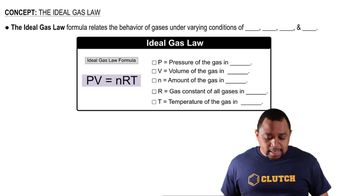
The Ideal Gas Law relates the pressure, volume, temperature, and number of moles of a gas through the equation PV = nRT. In this scenario, since temperature and pressure are constant, the relationship between the number of moles and volume can be simplified, allowing us to determine how the volume changes with the addition of more gas.
Recommended video:
Guided course
Ideal Gas Law Formula
Avogadro's Law
Avogadro's Law states that at constant temperature and pressure, the volume of a gas is directly proportional to the number of moles of gas present. This principle is crucial for solving the problem, as it allows us to predict how the volume will increase when additional moles of gas are added to the cylinder.
Conservation of Volume
In a closed system with a moveable piston, the total volume can change as gas is added or removed. The conservation of volume principle indicates that the volume of the gas will adjust to accommodate the new amount of gas while maintaining constant temperature and pressure, which is essential for calculating the new volume after adding more moles.
Recommended video:
Guided course
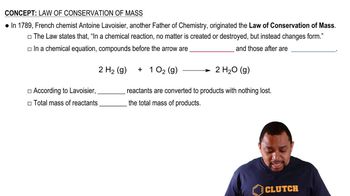
Law of Conservation of Mass
Related Practice
Textbook Question
1838
views
1
comments
Textbook Question
A syringe containing 1.55 mL of oxygen gas is cooled from 95.3 °C to 0.0 °C. What is the final volume of oxygen gas?
2837
views
1
rank
Textbook Question
What volume is occupied by 0.118 mol of helium gas at a pressure of 0.97 atm and a temperature of 305 K?
817
views
Textbook Question
A 48.3-mL sample of gas in a cylinder is warmed from 22 °C to 87 °C. What is its volume at the final temperature?
2726
views
1
rank
1
comments
Textbook Question
What volume is occupied by 0.118 mol of helium gas at a pressure of 0.97 atm and a temperature of 305 K? Would the volume be different if the gas was argon (under the same conditions)?
1929
views
1
rank
Textbook Question
A balloon contains 0.119 mol of gas and has a volume of 3.21 L. If an additional 0.103 mol of gas is added to the balloon (at constant temperature and pressure), what is its final volume?
1
views