
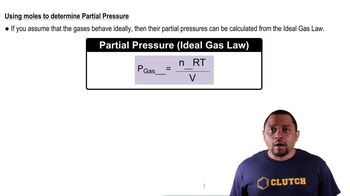
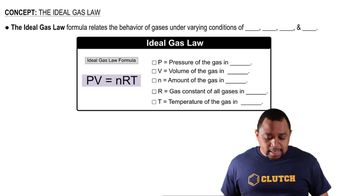
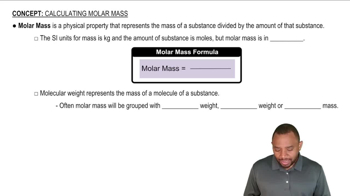
Carbon monoxide gas reacts with hydrogen gas to form methanol. CO(g) + 2 H2(g) → CH3OH(g) A 1.50-L reaction vessel, initially at 305 K, contains carbon monoxide gas at a partial pressure of 232 mmHg and hydrogen gas at a partial pressure of 397 mmHg. Identify the limiting reactant. Determine the theoretical yield of methanol in grams.

A flask at room temperature contains exactly equal amounts (in moles) of nitrogen and xenon. a. Which of the two gases exerts the greater partial pressure?
Verified step by step guidance
Verified video answer for a similar problem:
Key Concepts
Partial Pressure
Ideal Gas Law
Molar Mass and Density
Ozone is depleted in the stratosphere by chlorine from CF3Cl according to this set of equations:
CF3Cl + UV light → CF3 + Cl
Cl + O3 → ClO + O2
O3 + UV light → O2 + O
ClO + O → Cl + O2
What total volume of ozone at a pressure of 25.0 mmHg and a temperature of 225 K is destroyed when all of the chlorine from 15.0 g of CF3Cl goes through 10 cycles of the given reactions?
Calculate the root mean square velocity and kinetic energy of F2, Cl2, and Br2 at 298 K. Rank these three halogens with respect to their rate of effusion.
Chlorine gas reacts with fluorine gas to form chlorine trifluoride. Cl2(g) + 3 F2(g) → 2 ClF3(g) A 2.00-L reaction vessel, initially at 298 K, contains chlorine gas at a partial pressure of 337 mmHg and fluorine gas at a partial pressure of 729 mmHg. Identify the limiting reactant. Determine the theoretical yield of ClF3 in grams.
Calculate the root mean square velocity of F2, Cl2, and Br2 at 298 K.
A flask at room temperature contains exactly equal amounts (in moles) of nitrogen and xenon. c. The molecules of which gas have the greater average kinetic energy?
