
Ch.6 - Gases
Tro - Chemistry: A Molecular Approach 6th Edition
Tro6th EditionChemistry: A Molecular ApproachISBN: 9780137832217Not the one you use?Change textbook
Chapter 6, Problem 51

A piece of dry ice (solid carbon dioxide) with a mass of 22.1 g sublimes (converts from solid to gas) into a large balloon. Assuming that all of the carbon dioxide ends up in the balloon, what is the volume of the balloon at and a pressure of 742 mmHg?

Verified step by step guidance
1
Identify the given values: mass of CO2 = 22.1 g, pressure = 742 mmHg, temperature = 25°C (which is 298 K).
Convert the mass of CO2 to moles using the molar mass of CO2 (44.01 g/mol).
Use the ideal gas law equation, PV = nRT, to solve for the volume V. Here, P is the pressure in atm, n is the number of moles, R is the ideal gas constant (0.0821 L·atm/mol·K), and T is the temperature in Kelvin.
Convert the pressure from mmHg to atm by dividing by 760 mmHg/atm.
Substitute the values of n, R, T, and P into the ideal gas law equation to solve for V, the volume of the balloon.

Verified video answer for a similar problem:

This video solution was recommended by our tutors as helpful for the problem above.
Video duration:
7m
Was this helpful?

Key Concepts

Here are the essential concepts you must grasp in order to answer the question correctly.

Ideal Gas Law

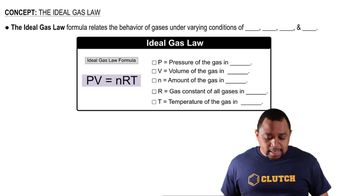
The Ideal Gas Law is a fundamental equation in chemistry that relates the pressure, volume, temperature, and number of moles of a gas. It is expressed as PV = nRT, where P is pressure, V is volume, n is the number of moles, R is the ideal gas constant, and T is temperature in Kelvin. This law allows us to calculate the volume of a gas when the amount of substance and conditions are known.
Recommended video:
Guided course
01:15
Ideal Gas Law Formula

Molar Mass of Carbon Dioxide

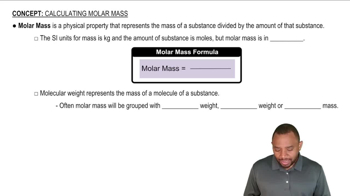
The molar mass of carbon dioxide (CO2) is essential for converting the mass of dry ice into moles. The molar mass is calculated by adding the atomic masses of its constituent elements: carbon (12.01 g/mol) and oxygen (16.00 g/mol). Since CO2 has one carbon atom and two oxygen atoms, its molar mass is approximately 44.01 g/mol, which is used to determine the number of moles from the given mass.
Recommended video:
Guided course
02:11
Molar Mass Concept

Gas Volume and Pressure Relationship

The relationship between gas volume and pressure is described by Boyle's Law, which states that at constant temperature, the volume of a gas is inversely proportional to its pressure. This means that if the pressure increases, the volume decreases, and vice versa. Understanding this relationship is crucial for calculating the volume of the balloon when the pressure of the gas is provided.
Recommended video:
Guided course
01:09
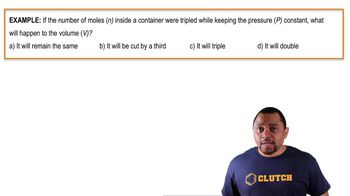
Relationship of Volume and Moles Example
Related Practice
Textbook Question

An automobile tire has a maximum rating of 38.0 psi (gauge pressure). The tire is inflated (while cold) to a volume of 11.8 L and a gauge pressure of 36.0 psi at a temperature of 12.0 °C. On a hot day, the tire warms to 65.0 °C, and its volume expands to 12.2 L. Does the pressure in the tire exceed its maximum rating? (Note: The gauge pressure is the difference between the total pressure and atmospheric pressure. In this case, assume that atmospheric pressure is 14.7 psi.)

1711
views
Textbook Question

A 2.0-L container of liquid nitrogen is kept in a closet measuring 1.0 m by 1.0 m by 2.0 m. Assuming that the container is completely full, that the temperature is 25.0°C, and that the atmospheric pressure is 1.0 atm, calculate the percent (by volume) of air that is displaced if all of the liquid nitrogen evaporates. (Liquid nitrogen has a density of 0.807 g/mL.)

Textbook Question

A weather balloon is inflated to a volume of 28.5 L at a pressure of 748 mmHg and a temperature of 28.0 °C. The balloon rises in the atmosphere to an altitude of approximately 25,000 ft, where the pressure is 385 mmHg and the temperature is -15.0 °C. Assuming the balloon can freely expand, calculate the volume of the balloon at this altitude.

6407
views
2
rank
Textbook Question

Which gas sample has the greatest pressure? Assume that all the samples are at the same temperature. Explain.

1333
views
Textbook Question

What is the temperature of 3.05 g of helium gas at a pressure of 1.70 atm and a volume of 14.1 L?