A mixture of CO(g) and O2(g) in a 1.0-L container at 1.0×10³ K has a total pressure of 2.2 atm. After some time, the total pressure falls to 1.9 atm as the result of the formation of CO2. Determine the mass (in grams) of CO2 that forms.

An 11.5-mL sample of liquid butane (density = 0.573 g/mL) is evaporated in an otherwise empty container at a temperature of 28.5 °C. The pressure in the container following evaporation is 892 torr. What is the volume of the container?
Verified step by step guidance
Verified video answer for a similar problem:
Key Concepts
Density and Mass Calculation
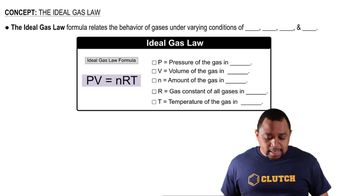
Ideal Gas Law
Conversion of Units
An ordinary gasoline can measuring 30.0 cm by 20.0 cm by 15.0 cm is evacuated with a vacuum pump. Assuming that virtually all of the air can be removed from inside the can and that atmospheric pressure is 14.7 psi, what is the total force (in pounds) on the surface of the can? Do you think that the can could withstand the force?
A catalytic converter in an automobile uses a palladium or platinum catalyst (a substance that increases the rate of a reaction without being consumed by the reaction) to convert carbon monoxide gas to carbon dioxide according to the reaction: 2 CO(g) + O2(g) → 2 CO2(g) A chemist researching the effectiveness of a new catalyst combines a 2.0:1.0 mole ratio mixture of carbon monoxide and oxygen gas (respectively) over the catalyst in a 2.45-L flask at a total pressure of 745 torr and a temperature of 552 °C. When the reaction is complete, the pressure in the flask has dropped to 552 torr. What percentage of the carbon monoxide was converted to carbon dioxide?
