
Ch.5 - Introduction to Solutions and Aqueous Solutions
Tro - Chemistry: A Molecular Approach 6th Edition
Tro6th EditionChemistry: A Molecular ApproachISBN: 9780137832217Not the one you use?Change textbook
Chapter 5, Problem 62b

Complete and balance each acid–base equation. b. HC2H3O2(aq) + Ca(OH)2(aq) →

Verified step by step guidance
1
Identify the reactants: acetic acid \((\text{HC}_2\text{H}_3\text{O}_2)\) and calcium hydroxide \((\text{Ca(OH)}_2)\).
Determine the products: the reaction between an acid and a base typically produces water \((\text{H}_2\text{O})\) and a salt. Here, the salt is calcium acetate \((\text{Ca(C}_2\text{H}_3\text{O}_2)_2)\).
Write the unbalanced chemical equation: \(\text{HC}_2\text{H}_3\text{O}_2(aq) + \text{Ca(OH)}_2(aq) \rightarrow \text{Ca(C}_2\text{H}_3\text{O}_2)_2(aq) + \text{H}_2\text{O}(l)\).
Balance the equation by adjusting coefficients to ensure the same number of each type of atom on both sides. Start by balancing the acetate ions \((\text{C}_2\text{H}_3\text{O}_2^-)\), then balance the calcium \((\text{Ca}^{2+})\), and finally the water molecules.
Verify that the equation is balanced by counting the atoms of each element on both sides of the equation.

Verified video answer for a similar problem:

This video solution was recommended by our tutors as helpful for the problem above.
Video duration:
3m
Was this helpful?

Key Concepts

Here are the essential concepts you must grasp in order to answer the question correctly.

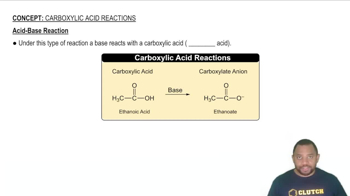
Acid-Base Reactions

Acid-base reactions involve the transfer of protons (H+) between reactants. In this context, acetic acid (HC2H3O2) acts as an acid, donating a proton, while calcium hydroxide (Ca(OH)2) serves as a base, accepting the proton. Understanding this transfer is crucial for predicting the products of the reaction.
Recommended video:
Guided course
01:09
Acid-Base Reaction

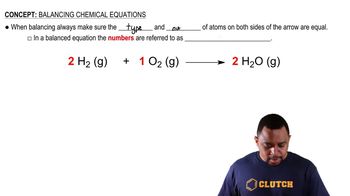
Balancing Chemical Equations

Balancing chemical equations ensures that the number of atoms for each element is the same on both sides of the equation. This is based on the law of conservation of mass, which states that matter cannot be created or destroyed in a chemical reaction. Proper balancing is essential for accurately representing the stoichiometry of the reaction.
Recommended video:
Guided course
01:32
Balancing Chemical Equations

Products of Acid-Base Neutralization

In a typical acid-base neutralization reaction, the products are usually a salt and water. In this case, the reaction between acetic acid and calcium hydroxide will produce calcium acetate and water. Recognizing the expected products helps in correctly completing and balancing the equation.
Recommended video:
Guided course
05:04
Lewis Acids and Bases
Related Practice
Textbook Question

A 25.00-mL sample of an unknown H3PO4 solution is titrated with a 0.150 M NaOH solution. The equivalence point is reached when 22.97 mL of NaOH solution is added. What is the concentration of the unknown H3PO4 solution? The neutralization reaction is H3PO4(aq) + 3 NaOH(aq) → 3 H2O(l) + Na3PO4(aq)

Textbook Question

Write balanced molecular and net ionic equations for the reaction between hydrochloric acid and rubidium hydroxide.

1
views
Textbook Question

Lead(II) ions can be removed from solution by precipitation with sulfate ions. Suppose that a solution contains lead(II) nitrate. Write complete ionic and net ionic equations for the reaction of aqueous lead(II) nitrate with aqueous potassium sulfate to form solid lead(II) sulfate and aqueous potassium nitrate.

1328
views
Textbook Question

Mercury(I) ions (Hg22+) can be removed from solution by precipitation with Cl- Suppose that a solution contains aqueous Hg2(NO3)2. Write complete ionic and net ionic equations for the reaction of aqueous Hg2(NO3)2 with aqueous sodium chloride to form solid Hg2Cl2 and aqueous sodium nitrate.

1115
views
Textbook Question

A 15.00-mL sample of an unknown HClO4 solution requires titration with 17.03 mL of 0.1000 M NaOH to reach the equivalence point. What is the concentration of the unknown HClO4 solution? The neutralization reaction is HClO4(aq) + NaOH(aq) → H2O(l ) + NaClO4(aq)

Textbook Question

Write balanced complete ionic and net ionic equations for each acid–base reaction.

b. HCHO2(aq) + NaOH(aq) →

c. HC2H3O2(aq) + LiOH(aq) →

991
views