A 25.00-mL sample of an unknown H3PO4 solution is titrated with a 0.150 M NaOH solution. The equivalence point is reached when 22.97 mL of NaOH solution is added. What is the concentration of the unknown H3PO4 solution? The neutralization reaction is H3PO4(aq) + 3 NaOH(aq) → 3 H2O(l) + Na3PO4(aq)
Ch.5 - Introduction to Solutions and Aqueous Solutions

Chapter 5, Problem 68a
Complete and balance each gas-evolution equation. a. HNO3(aq) + Na2SO3(aq) →
Verified step by step guidance1
Identify the reactants: HNO_3 (aq) and Na_2SO_3 (aq).
Determine the products: The reaction between an acid (HNO_3) and a sulfite (Na_2SO_3) typically produces a salt (NaNO_3), water (H_2O), and sulfur dioxide gas (SO_2).
Write the unbalanced chemical equation: HNO_3 (aq) + Na_2SO_3 (aq) \(\rightarrow\) NaNO_3 (aq) + H_2O (l) + SO_2 (g).
Balance the equation: Start by balancing the number of sodium (Na) atoms, then balance the nitrogen (N) atoms, followed by the oxygen (O) and hydrogen (H) atoms.
Verify that the number of atoms for each element is equal on both sides of the equation to ensure it is balanced.

Verified video answer for a similar problem:
This video solution was recommended by our tutors as helpful for the problem above.
Video duration:
4mWas this helpful?
Key Concepts
Here are the essential concepts you must grasp in order to answer the question correctly.
Gas-Evolution Reactions
Gas-evolution reactions are chemical reactions that produce a gas as one of the products. These reactions often involve the combination of an acid with a carbonate, sulfite, or other compounds that release gas when they react. Understanding the nature of the reactants and the expected gas products is crucial for predicting the outcome of these reactions.
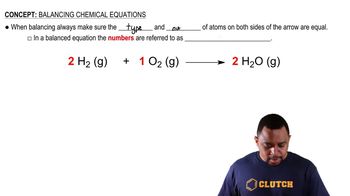
Balancing Chemical Equations
Balancing chemical equations is the process of ensuring that the number of atoms for each element is the same on both sides of the equation. This is achieved by adjusting the coefficients of the reactants and products. A balanced equation reflects the law of conservation of mass, which states that matter cannot be created or destroyed in a chemical reaction.
Recommended video:
Guided course
Balancing Chemical Equations
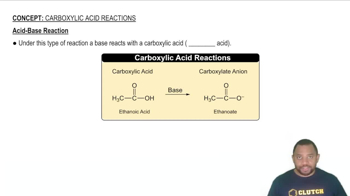
Acid-Base Reactions
Acid-base reactions involve the transfer of protons (H⁺ ions) between reactants. In the context of the given equation, nitric acid (HNO3) acts as an acid, while sodium sulfite (Na2SO3) can act as a base. Recognizing the roles of acids and bases in a reaction helps in predicting the products formed, including any gases that may evolve.
Recommended video:
Guided course
Acid-Base Reaction
Related Practice
Textbook Question
Textbook Question
Complete and balance each gas-evolution equation. c. HBr(aq) + Na2S(aq) →
515
views
Textbook Question
A 15.00-mL sample of an unknown HClO4 solution requires titration with 17.03 mL of 0.1000 M NaOH to reach the equivalence point. What is the concentration of the unknown HClO4 solution? The neutralization reaction is HClO4(aq) + NaOH(aq) → H2O(l ) + NaClO4(aq)
Textbook Question
What is the oxidation state of Cr in each compound? b. CrO3
604
views
Textbook Question
What is the oxidation state of Cr in each compound? c. Cr2O3
607
views
Textbook Question
Assign oxidation states to each atom in each element, ion, or compound. Cl2, Fe3+, CuCl2, CH4, Cr2O72–, HSO4–
954
views
