
Textbook Question
Predict the products and write a balanced molecular equation for each reaction. If no reaction occurs, write 'NO REACTION.' d. aqueous ammonium chloride and aqueous calcium hydroxide
723
views

 Verified step by step guidance
 01:09
01:09
 01:32
01:32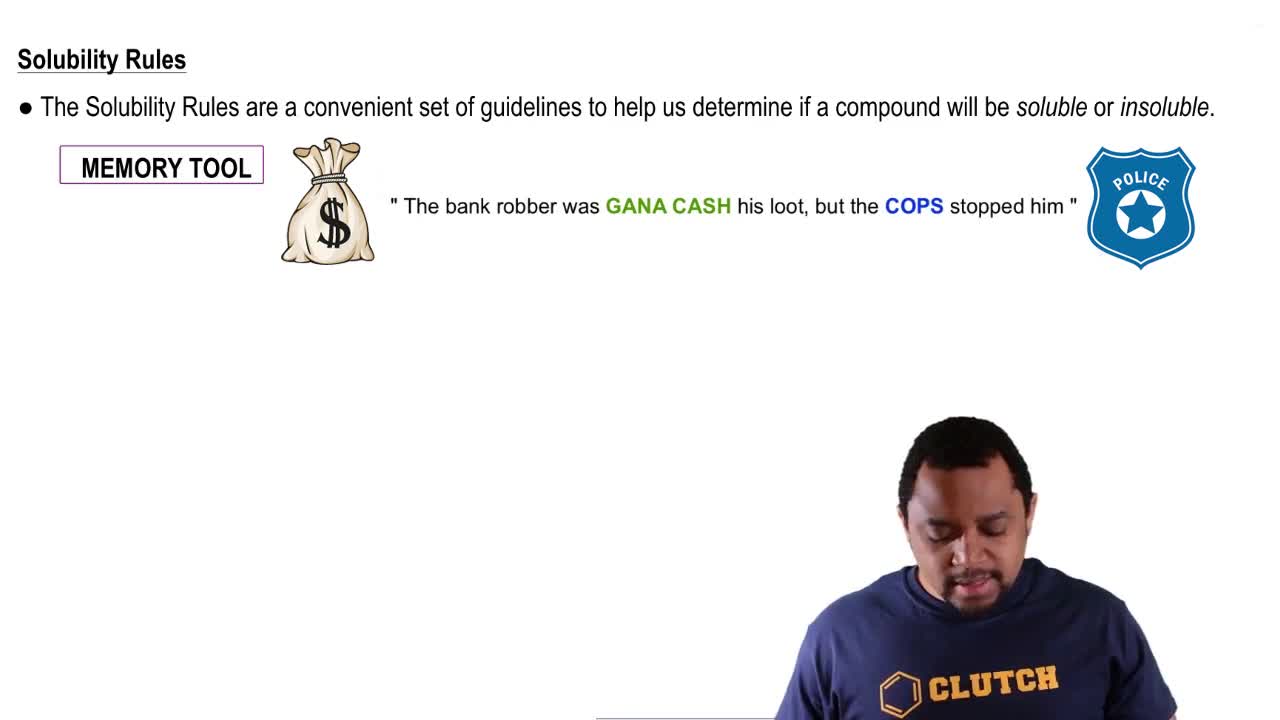 00:28
00:28Predict the products and write a balanced molecular equation for each reaction. If no reaction occurs, write 'NO REACTION.' d. aqueous ammonium chloride and aqueous calcium hydroxide
Determine whether each reaction is a redox reaction. For each redox reaction, identify the oxidizing agent and the reducing agent. c. Pb(NO3)2(aq) + Na2SO4(aq) → PbSO4(s) + 2 NaNO3(aq) d. HBr(aq) + KOH(aq) → H2O(l) + KBr(aq)
Hard water often contains dissolved Ca2+ and Mg2+ ions. One way to soften water is to add phosphates. The phosphate ion forms insoluble precipitates with calcium and magnesium ions, removing them from solution. A solution is 0.050 M in calcium chloride and 0.085 M in magnesium nitrate. What mass of sodium phosphate would you add to 1.5 L of this solution to completely eliminate the hard water ions? Assume complete reaction.
Predict the products and write a balanced molecular equation for each reaction. If no reaction occurs, write 'NO REACTION.' c. liquid pentanol (C5H12O) and gaseous oxygen
Determine whether each reaction is a redox reaction. For each redox reaction, identify the oxidizing agent and the reducing agent. a. Al(s) + 3 Ag+(aq) → Al3+(aq) + 3 Ag(s) b. SO3(g) + H2O(l) → H2SO4(aq) c. Ba(s) + Cl2(g) → BaCl2(s) d. Mg(s) + Br2(l) → MgBr2(s)