
Identify each energy exchange as primarily heat or work and determine whether the sign of ΔE is positive or negative for the system. a. Sweat evaporates from skin, cooling the skin. (The evaporating sweat is the system.)
Ch.7 - Thermochemistry

Chapter 7, Problem 34c
Convert between energy units. c. 4.99 × 10³ kJ to kWh
Verified step by step guidance1
Identify the conversion factor between kilojoules (kJ) and kilowatt-hours (kWh). The conversion factor is 1 kWh = 3600 kJ.
Write down the given energy in kilojoules, which is 4.99 \(\times\) 10^3 kJ.
Set up the conversion equation using the conversion factor. You want to convert kJ to kWh, so divide the energy in kJ by the conversion factor (3600 kJ/kWh).
Perform the division to convert the energy from kJ to kWh. This involves dividing 4.99 \(\times\) 10^3 kJ by 3600 kJ/kWh.
The result from the division will give you the energy in kilowatt-hours (kWh).

Verified video answer for a similar problem:
This video solution was recommended by our tutors as helpful for the problem above.
Video duration:
57sWas this helpful?
Key Concepts
Here are the essential concepts you must grasp in order to answer the question correctly.
Energy Units
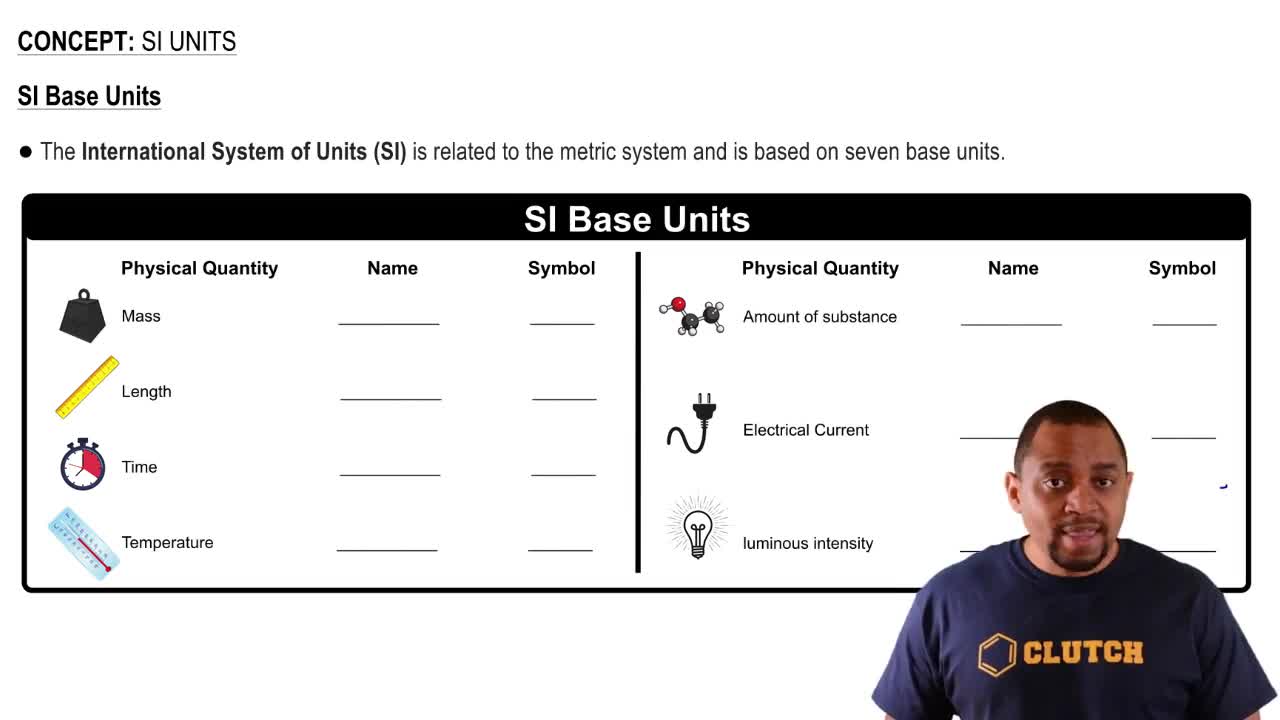
Energy can be measured in various units, with kilojoules (kJ) and kilowatt-hours (kWh) being common in chemistry and electrical contexts. A kilojoule is a unit of energy equal to 1,000 joules, while a kilowatt-hour is the energy consumed by a power of one kilowatt running for one hour, equivalent to 3.6 million joules.
Recommended video:
Guided course
SI Units
Conversion Factors
To convert between different energy units, specific conversion factors are used. For instance, to convert kJ to kWh, one must know that 1 kWh equals 3.6 million joules. Therefore, the conversion involves dividing the energy in kJ by 3,600 to obtain the equivalent in kWh.
Recommended video:
Guided course
Conversion Factors
Dimensional Analysis
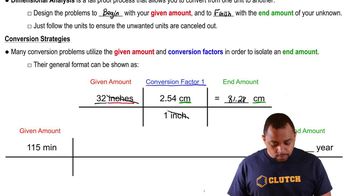
Dimensional analysis is a mathematical technique used to convert units by multiplying by conversion factors that cancel out unwanted units. This method ensures that the final answer is in the desired unit, making it a crucial tool for solving problems involving unit conversions in chemistry.
Recommended video:
Guided course
Dimensional Analysis
Related Practice
Textbook Question
1193
views
1
rank
2
comments
Textbook Question
Identify each energy exchange as primarily heat or work and determine whether the sign of ΔE is positive or negative for the system. a. Sweat evaporates from skin, cooling the skin. (The evaporating sweat is the system.) b. A balloon expands against an external pressure. (The contents of the balloon is the system.) c. An aqueous chemical reaction mixture is warmed with an external flame. (The reaction mixture is the system.) Identify energy exchanges as primarily heat or work. Determine whether the sign of E is positive or negative for the system.
1287
views
Textbook Question
Suppose that a person eats 2105 Calories per day. Convert this amount of energy into each unit. c. kWh
