
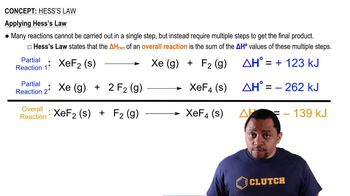
Calculate ΔHrxn for the reaction:
5 C(s) + 6 H2(g) → C5H12(l)
Use the following reactions and given ΔH's:
C5H12(l) + 8 O2(g) → 5 CO2(g) + 6 H2O(g) ΔH = –3244.8 kJ
C(s) + O2(g) → CO2(g) ΔH = –393.5 kJ
2 H2(g) + O2(g) → 2 H2O(g) ΔH = –483.5 kJ

Verified step by step guidanceCalculate ΔHrxn for the reaction:
5 C(s) + 6 H2(g) → C5H12(l)
Use the following reactions and given ΔH's:
C5H12(l) + 8 O2(g) → 5 CO2(g) + 6 H2O(g) ΔH = –3244.8 kJ
C(s) + O2(g) → CO2(g) ΔH = –393.5 kJ
2 H2(g) + O2(g) → 2 H2O(g) ΔH = –483.5 kJ
Use standard enthalpies of formation to calculate ΔH°rxn for each reaction. a. C2H4(g) + H2(g) → C2H6(g)
Write an equation for the formation of each compound from its elements in their standard states, and find ΔH°rxn for each in Appendix IIB. d. CH3OH(l)
Write an equation for the formation of each compound from its elements in their standard states, and find ΔH°rxn for each in Appendix IIB. b. MgCO3(s)
Pentane (C5H12) is a component of gasoline that burns according to the following balanced equation: C5H12(l) + 8 O2(g) → 5 CO2(g) + 6 H2O(g) Calculate ΔH°rxn for this reaction using standard enthalpies of formation. (The standard enthalpy of formation of liquid pentane is –146.8 kJ/mol.)