
Ch.7 - Thermochemistry
Tro - Chemistry: A Molecular Approach 6th Edition
Tro6th EditionChemistry: A Molecular ApproachISBN: 9780137832217Not the one you use?Change textbook
Chapter 7, Problem 42

Identify each energy exchange as primarily heat or work and determine whether the sign of ΔE is positive or negative for the system. Identify each energy exchange as primarily heat or work. a. A rolling billiard ball collides with another billiard ball. The first billiard ball (defined as the system) stops rolling after the collision. b. A book falls to the floor. (The book is the system). c. A father pushes his daughter on a swing. (The daughter and the swing are the system). Identify each energy exchange as primarily heat or work.

Verified step by step guidance
1
a. In the scenario where a rolling billiard ball collides with another and stops, the energy exchange involves kinetic energy being transferred from the first ball to the second. This is primarily an example of work being done on the second ball by the first ball. Since the first ball loses kinetic energy, the sign of ΔE for the first ball (the system) is negative.
b. When a book falls to the floor, gravitational potential energy is converted into kinetic energy as it falls. This is an example of work being done by gravity on the book. As the book gains kinetic energy while falling, the sign of ΔE for the book (the system) is positive.
c. As a father pushes his daughter on a swing, he applies a force that does work on the swing system, transferring energy to it. This is primarily an example of work. Since the system (daughter and swing) gains energy from the father's push, the sign of ΔE for the system is positive.

Verified video answer for a similar problem:

This video solution was recommended by our tutors as helpful for the problem above.
Video duration:
1m
Was this helpful?

Key Concepts

Here are the essential concepts you must grasp in order to answer the question correctly.

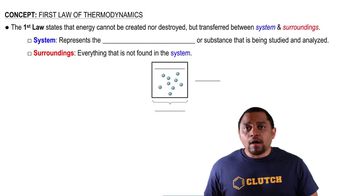
First Law of Thermodynamics

The First Law of Thermodynamics states that energy cannot be created or destroyed, only transformed from one form to another. This principle is crucial for analyzing energy exchanges in systems, as it helps determine how energy is conserved during processes like collisions or movements. Understanding this law allows us to assess whether energy is being added to or removed from a system, which is essential for evaluating the sign of ΔE.
Recommended video:
Guided course
01:18
First Law of Thermodynamics

Heat vs. Work

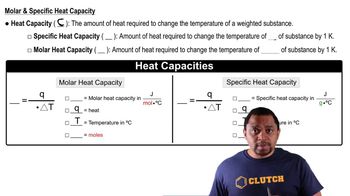
In thermodynamics, heat and work are two distinct forms of energy transfer. Heat refers to energy transferred due to a temperature difference, while work is energy transferred when a force is applied over a distance. Identifying whether an energy exchange is primarily heat or work is vital for understanding how energy flows in a system and affects its internal energy, ΔE.
Recommended video:
Guided course
02:19
Heat Capacity

Sign Convention for ΔE

The sign of ΔE, or the change in internal energy of a system, indicates whether the system has gained or lost energy. A positive ΔE means the system has gained energy (e.g., through heat absorption or work done on it), while a negative ΔE indicates energy loss. This convention is essential for interpreting the outcomes of energy exchanges in various scenarios, such as collisions or mechanical work.
Related Practice
Textbook Question

We pack two identical coolers for a picnic, placing 24 12-ounce soft drinks and five pounds of ice in each. However, the drinks that we put into cooler A were refrigerated for several hours before they were packed in the cooler, while the drinks that we put into cooler B were at room temperature. When we open the two coolers three hours later, most of the ice in cooler A is still present, while nearly all of the ice in cooler B has melted. Explain this difference.

1120
views
Textbook Question

A system releases 511 kJ of heat and does 125 kJ of work on the surroundings. What is the change in internal energy of the system?

2
views
Textbook Question

Identify each energy exchange as primarily heat or work and determine whether the sign of ΔE is positive or negative for the system. a. Sweat evaporates from skin, cooling the skin. (The evaporating sweat is the system.)

1193
views
1
rank
2
comments
Textbook Question

Identify each energy exchange as primarily heat or work and determine whether the sign of ΔE is positive or negative for the system. a. Sweat evaporates from skin, cooling the skin. (The evaporating sweat is the system.) b. A balloon expands against an external pressure. (The contents of the balloon is the system.) c. An aqueous chemical reaction mixture is warmed with an external flame. (The reaction mixture is the system.) Identify energy exchanges as primarily heat or work. Determine whether the sign of E is positive or negative for the system.

1287
views
Textbook Question

Suppose that a person eats 2105 Calories per day. Convert this amount of energy into each unit. c. kWh

Textbook Question

The air in an inflated balloon (defined as the system) warms over a toaster and absorbs 142 J of heat. As it expands, it does 46 kJ of work. What is the change in internal energy for the system?

1
views