Use Coulomb's law to calculate the ionization energy in kJ/mol of an atom composed of a proton and an electron separated by 110.00 pm. What wavelength of light has sufficient energy to ionize the atom?
Ch.9 - Periodic Properties of the Elements

Chapter 9, Problem 114b
Consider the elements: Na, Mg, Al, Si, P. b. Which element has the smallest atomic radius?
Verified step by step guidance1
Identify the elements given: Na, Mg, Al, Si, P.
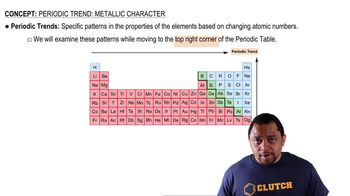
Recall that atomic radius generally decreases across a period from left to right on the periodic table.
Locate the elements on the periodic table: they are all in the same period (Period 3).
Compare their positions: Na is furthest left, and P is furthest right.
Conclude that the element furthest to the right (P) has the smallest atomic radius due to increased nuclear charge pulling electrons closer.
Key Concepts
Here are the essential concepts you must grasp in order to answer the question correctly.
Atomic Radius
The atomic radius is a measure of the size of an atom, typically defined as the distance from the nucleus to the outermost electron shell. It can vary depending on the type of bond the atom is involved in, but generally, atomic radius decreases across a period in the periodic table due to increased nuclear charge, which pulls electrons closer to the nucleus.
Periodic Trends
Periodic trends refer to predictable patterns in the properties of elements as you move across or down the periodic table. For atomic radius, the trend shows that it decreases from left to right across a period and increases from top to bottom within a group, influenced by factors such as effective nuclear charge and electron shielding.
Recommended video:
Guided course
Periodic Trends
Effective Nuclear Charge
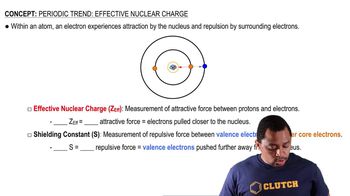
Effective nuclear charge (Z_eff) is the net positive charge experienced by an electron in a multi-electron atom. It accounts for the shielding effect of inner electrons, which reduces the full nuclear charge felt by outer electrons. A higher Z_eff leads to a smaller atomic radius, as electrons are drawn closer to the nucleus.
Recommended video:
Guided course
Effective Nuclear Charge
Related Practice
Textbook Question
2
views
Textbook Question
You have cracked a secret code that uses elemental symbols to spell words. The code uses numbers to designate the elemental symbols. Each number is the sum of the atomic number and the highest principal quantum number of the highest occupied orbital of the element whose symbol is to be used. The message may be written forward or backward. Decode the following messages: a. 10, 12, 58, 11, 7, 44, 63, 66
2960
views
Textbook Question
Consider the elements: Na, Mg, Al, Si, P. d. Which element is diamagnetic?
919
views
Textbook Question
Consider the elements: Na, Mg, Al, Si, P. c. Which element is least metallic?
539
views
Textbook Question
Consider the elements: B, C, N, O, F. d. Which element has three unpaired electrons?
350
views