
Diazomethane is a highly poisonous, explosive compound because it readily evolves N2. Diazomethane has the following composition by mass: 28.57% C; 4.80% H; and 66.64% N. The molar mass of diazomethane is 42.04 g/mol. Find the molecular formula of diazomethane, draw its Lewis structure, and assign formal charges to each atom. Why is diazomethane not very stable? Explain.
Ch.10 - Chemical Bonding I: The Lewis Model

Chapter 10, Problem 97
Formic acid is responsible for the sting of ant bites. By mass, formic acid is 26.10% C, 4.38% H, and 69.52% O. The molar mass of formic acid is 46.02 g/mol. Determine the molecular formula of formic acid and draw its Lewis structure.
Verified step by step guidance1
Step 1: Assume you have 100 g of formic acid, which allows you to directly convert the percentage composition to grams: 26.10 g of C, 4.38 g of H, and 69.52 g of O.
Step 2: Convert the mass of each element to moles by dividing by their respective atomic masses: C (12.01 g/mol), H (1.008 g/mol), and O (16.00 g/mol).
Step 3: Determine the simplest whole number ratio of moles of each element by dividing each by the smallest number of moles calculated in Step 2.
Step 4: Use the simplest whole number ratio to write the empirical formula of formic acid.
Step 5: Calculate the empirical formula mass and compare it to the given molar mass (46.02 g/mol) to find the molecular formula. Then, draw the Lewis structure based on the molecular formula, ensuring all atoms satisfy the octet rule where applicable.
Key Concepts
Here are the essential concepts you must grasp in order to answer the question correctly.
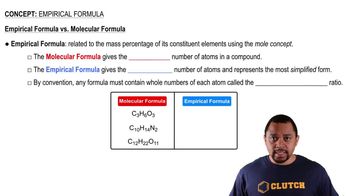
Empirical Formula
The empirical formula represents the simplest whole-number ratio of the elements in a compound. To determine it, the percentage composition of each element is converted to moles, and then the mole ratios are simplified. For formic acid, the empirical formula can be derived from its mass percentages of carbon, hydrogen, and oxygen.
Recommended video:
Guided course
Empirical vs Molecular Formula
Molecular Formula
The molecular formula indicates the actual number of atoms of each element in a molecule of a compound. It can be derived from the empirical formula by comparing the molar mass of the compound to the molar mass of the empirical formula. In the case of formic acid, knowing its molar mass allows us to determine how many times the empirical formula fits into the molecular formula.
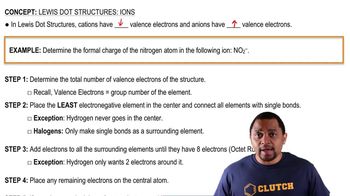
Lewis Structure
A Lewis structure is a diagram that represents the bonding between atoms in a molecule and the lone pairs of electrons. It helps visualize the arrangement of electrons and the connectivity of atoms. For formic acid, drawing the Lewis structure involves placing the correct number of valence electrons around the carbon, hydrogen, and oxygen atoms to satisfy the octet rule where applicable.
Recommended video:
Guided course
Lewis Dot Structures: Ions
Related Practice
Textbook Question
818
views
Textbook Question
Carbon ring structures are common in organic chemistry. Draw a Lewis structure for each carbon ring structure, including any necessary resonance structures. a. C4H8 b. C4H4 c. C6H12 d. C6H6
1248
views
Textbook Question
Amino acids are the building blocks of proteins. The simplest amino acid is glycine (H2NCH2COOH). Draw a Lewis structure for glycine. (Hint: The central atoms in the skeletal structure are nitrogen and the two carbon atoms. Each oxygen atom is bonded directly to the right-most carbon atom.)
1352
views
Textbook Question
NaCl has a lattice energy of -787 kJ/mol. Consider a hypothetical salt XY. X3+ has the same radius of Na+ and Y3- has the same radius as Cl-. Estimate the lattice energy of XY.
1192
views
