Back
Back
Problem 110
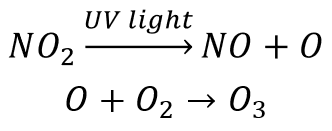
Free radicals are important in many environmentally significant reactions (see the Chemistry in the Environment box on free radicals in this chapter). For example, photochemical smog— smog that results from the action of sunlight on air pollutants— forms in part by these two steps:
The product of this reaction, ozone, is a pollutant in the lower atmosphere. (Upper atmospheric ozone is a natural part of the atmosphere that protects life on Earth from ultraviolet light.) Ozone is an eye and lung irritant and also accelerates the weathering of rubber products. Rewrite the given reactions using the Lewis structure of each reactant and product. Identify the free radicals.
Problem 111a
If hydrogen were used as a fuel, it could be burned according to this reaction: H2(g) + 1/2 O2(g) → H2O(g) Use average bond energies to calculate ΔHrxn for this reaction.
Problem 111b
If hydrogen were used as a fuel, it could be burned according to this reaction: H2(g) + 1/2 O2(g) → H2O(g) Use average bond energies to calculate ΔHrxn for the combustion of methane (CH4).
Problem 111c
If hydrogen were used as a fuel, it could be burned according to this reaction: H2(g) + 1/2 O2(g) → H2O(g) Which fuel yields more energy per mole?
Problem 111d
If hydrogen were used as a fuel, it could be burned according to this reaction: H2(g) + 1/2 O2(g) → H2O(g) Which fuel yields more energy per gram?
Problem 113c
Draw the Lewis structure for each compound. c. H3AsO4
Problem 114
The azide ion, N3-, is a symmetrical ion, all of whose contributing resonance structures have formal charges. Draw three important contributing structures for this ion.
Problem 118
Calculate the heat of atomization (see previous problem) of C2H3Cl, using the average bond energies in Table 10.3.
Problem 119
A compound composed of only carbon and hydrogen is 7.743% hydrogen by mass. Propose a Lewis structure for the compound.
Problem 120
A compound composed of only carbon and chlorine is 85.5% chlorine by mass. Propose a Lewis structure for the compound.