Examine the following diagrams of cells from an organism with diploid number 2n=6, and identify what stage of M phase is represented.
Table of contents
- 1. Introduction to Genetics51m
- 2. Mendel's Laws of Inheritance3h 37m
- 3. Extensions to Mendelian Inheritance2h 41m
- 4. Genetic Mapping and Linkage2h 28m
- 5. Genetics of Bacteria and Viruses1h 21m
- 6. Chromosomal Variation1h 48m
- 7. DNA and Chromosome Structure56m
- 8. DNA Replication1h 10m
- 9. Mitosis and Meiosis1h 34m
- 10. Transcription1h 0m
- 11. Translation58m
- 12. Gene Regulation in Prokaryotes1h 19m
- 13. Gene Regulation in Eukaryotes44m
- 14. Genetic Control of Development44m
- 15. Genomes and Genomics1h 50m
- 16. Transposable Elements47m
- 17. Mutation, Repair, and Recombination1h 6m
- 18. Molecular Genetic Tools19m
- 19. Cancer Genetics29m
- 20. Quantitative Genetics1h 26m
- 21. Population Genetics50m
- 22. Evolutionary Genetics29m
9. Mitosis and Meiosis
Mitosis
Problem 3
Textbook Question
What role do the following cellular components play in the storage, expression, or transmission of genetic information?
(a) Chromatin
(b) Nucleolus
(c) Ribosome
(d) Mitochondrion
(e) Centriole
(f) Centromere
Verified step by step guidance1
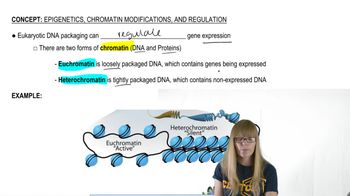
Identify the role of chromatin: Understand that chromatin is composed of DNA and proteins, and its primary function is to package DNA into a compact, dense shape, which facilitates storage and regulates gene expression by controlling access to the DNA.
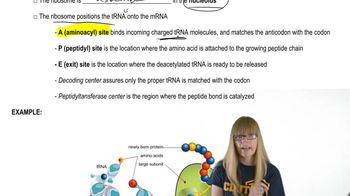
Explain the nucleolus: Recognize that the nucleolus is a region within the nucleus responsible for synthesizing ribosomal RNA (rRNA) and assembling ribosomal subunits, which are essential for protein synthesis, thus indirectly influencing gene expression.
Describe the ribosome's function: Know that ribosomes are the cellular machinery that translates messenger RNA (mRNA) into proteins, directly executing the genetic code and enabling gene expression.
Discuss the mitochondrion: Understand that mitochondria contain their own DNA and are involved in energy production; their genetic material is inherited maternally and plays a role in the transmission of genetic information across generations.
Clarify the roles of the centriole and centromere: Centrioles are involved in organizing the mitotic spindle during cell division, ensuring proper chromosome segregation (transmission of genetic information), while the centromere is the chromosome region where sister chromatids are held together and where spindle fibers attach, critical for accurate chromosome movement during cell division.
Verified video answer for a similar problem:This video solution was recommended by our tutors as helpful for the problem above
Video duration:
1mPlay a video:
Was this helpful?
Key Concepts
Here are the essential concepts you must grasp in order to answer the question correctly.
Chromatin and Genetic Information Storage
Chromatin is a complex of DNA and proteins found in the nucleus that packages genetic material into a compact, organized structure. It regulates gene expression by controlling DNA accessibility and plays a key role in DNA replication and repair, thus ensuring proper storage and transmission of genetic information.
Recommended video:
Guided course
Chromatin
Role of Ribosomes and Nucleolus in Gene Expression
The nucleolus is a nuclear substructure where ribosomal RNA (rRNA) is synthesized and ribosome assembly begins. Ribosomes, composed of rRNA and proteins, are the cellular machinery that translates messenger RNA (mRNA) into proteins, directly facilitating the expression of genetic information.
Recommended video:
Guided course
Ribosome Structure
Mitochondrion, Centriole, and Centromere Functions in Genetic Transmission
Mitochondria contain their own DNA and contribute to genetic inheritance through maternal lineage. Centrioles organize the mitotic spindle during cell division, ensuring accurate chromosome segregation. The centromere is the chromosome region where spindle fibers attach, critical for proper chromosome movement and genetic information transmission during mitosis.
Recommended video:
Guided course
Functional Genomics
Related Videos
Related Practice
Textbook Question
588
views