Pearson+ LogoPearson+ Logo
Ch. 13 - Translation and Proteins
Klug - Essentials of Genetics 10th Edition
Klug10th EditionEssentials of GeneticsISBN: 9780135588789Not the one you use?Change textbook
Chapter 13, Problem 3

List and describe the role of all molecular constituents present in a functional polyribosome.

Verified step by step guidance
1
Identify the main molecular constituents of a functional polyribosome, which include mRNA, ribosomes, tRNAs, and various associated proteins.
Describe the role of mRNA as the template that carries the genetic code from DNA to be translated into a polypeptide chain.
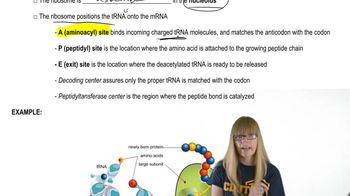
Explain that ribosomes are the molecular machines that read the mRNA sequence and catalyze the assembly of amino acids into a polypeptide chain; in a polyribosome, multiple ribosomes simultaneously translate a single mRNA molecule.
Discuss the function of tRNAs as adaptor molecules that bring specific amino acids to the ribosome according to the codon sequence on the mRNA, ensuring correct amino acid incorporation.
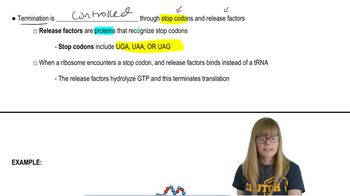
Mention additional factors such as initiation, elongation, and release factors that assist in the assembly, progression, and termination of translation within the polyribosome complex.

Key Concepts

Here are the essential concepts you must grasp in order to answer the question correctly.

Polyribosome Structure

A polyribosome, or polysome, is a complex formed when multiple ribosomes simultaneously translate a single mRNA molecule. This arrangement increases the efficiency of protein synthesis by allowing multiple copies of a protein to be produced concurrently from one mRNA strand.
Recommended video:
Guided course
03:49
Ribosome Structure

Molecular Constituents of Polyribosomes

Key molecular components include mRNA, multiple ribosomes (each composed of large and small subunits), tRNAs carrying amino acids, and various translation factors. These constituents work together to decode the mRNA sequence and synthesize the corresponding polypeptide chains.
Recommended video:
Guided course
07:11
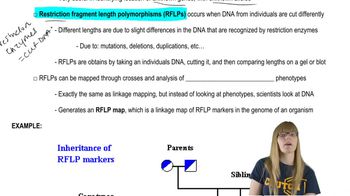
Mapping with Markers

Role of Translation Factors

Translation factors are proteins that assist in initiation, elongation, and termination phases of protein synthesis. They facilitate ribosome assembly on mRNA, ensure correct tRNA positioning, and help release the completed polypeptide, thus ensuring efficient and accurate translation within the polyribosome.
Recommended video:
Guided course
01:55
Translation Termination