Pearson+ LogoPearson+ Logo
Ch. 7 - Linkage and Chromosome Mapping in Eukaryotes
Klug - Essentials of Genetics 10th Edition
Klug10th EditionEssentials of GeneticsISBN: 9780135588789Not the one you use?Change textbook
Chapter 7, Problem 14c

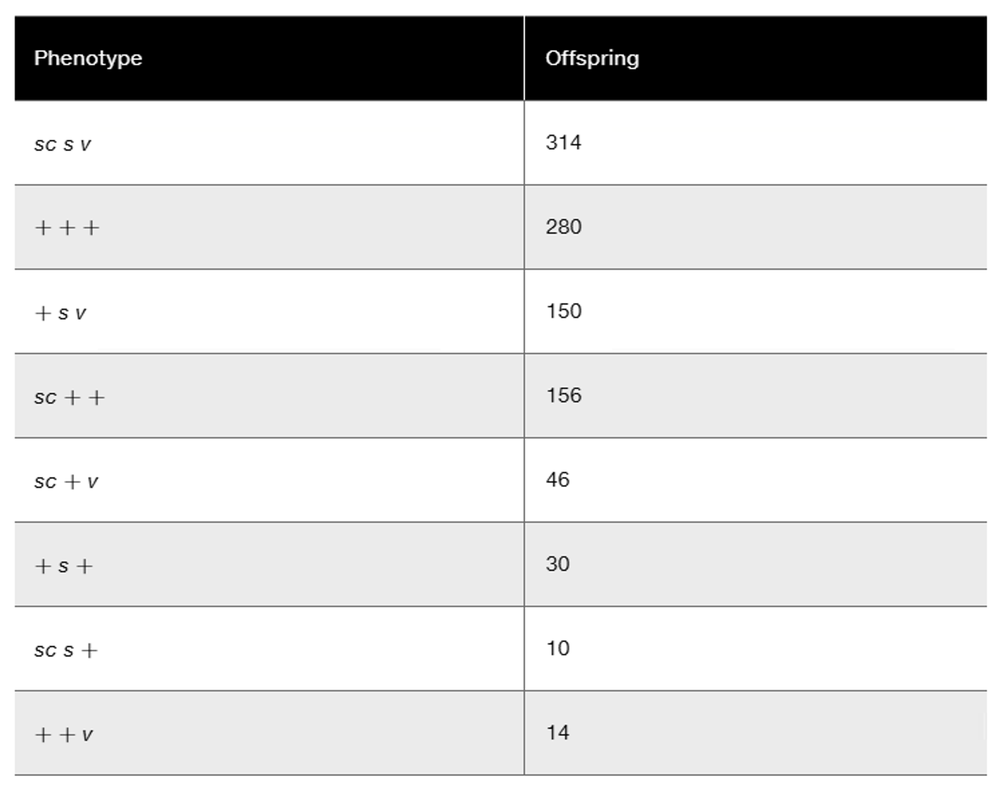
In Drosophila, a cross was made between females—all expressing the three X-linked recessive traits scute bristles (sc), sable body (s), and vermilion eyes (v)—and wild-type males. In the F1, all females were wild type, while all males expressed all three mutant traits. The cross was carried to the F2 generation, and 1000 offspring were counted, with the results shown in the following table.
Table showing offspring counts for eight phenotypes with combinations of three X-linked traits in Drosophila, totaling 1000.
No determination of sex was made in the data.
Are there more or fewer double crossovers than expected?

Verified step by step guidance
1
Step 1: Identify the parental and recombinant phenotypes. The parental phenotypes are the most frequent classes, which are 'sc s v' (314 offspring) and '+++ ' (280 offspring). The recombinant phenotypes include single and double crossovers with lower numbers.
Step 2: Determine the gene order on the X chromosome. Use the single crossover classes to infer the order of the three genes (sc, s, v). Compare the phenotypes that differ by one gene to establish the linear order.
Step 3: Calculate the recombination frequencies between each pair of genes. Use the formula for recombination frequency: \(\text{RF} = \frac{\text{Number of recombinant offspring}}{\text{Total offspring}}\). Calculate RF for sc-s and s-v intervals using the appropriate single crossover classes.
Step 4: Calculate the expected frequency of double crossovers. Multiply the recombination frequencies of the two intervals: \(\text{Expected double crossover frequency} = \text{RF}_{sc-s} \times \text{RF}_{s-v}\). Then multiply by the total number of offspring (1000) to get the expected number of double crossovers.
Step 5: Compare the observed number of double crossovers (sum of the two double crossover classes: 'sc + v' and '+ s +') to the expected number calculated in Step 4. Determine if there are more or fewer double crossovers than expected, which can indicate interference.

Verified video answer for a similar problem:

This video solution was recommended by our tutors as helpful for the problem above.
Video duration:
1m
Was this helpful?

Key Concepts

Here are the essential concepts you must grasp in order to answer the question correctly.

X-linked Inheritance

X-linked inheritance refers to genes located on the X chromosome, which show distinct inheritance patterns, especially in species like Drosophila. Males (XY) express recessive X-linked traits if they inherit a mutant allele, while females (XX) must inherit two copies. This concept is crucial for understanding the phenotypic ratios in crosses involving X-linked traits.
Recommended video:
Guided course
09:30
X-Inactivation

Genetic Recombination and Crossing Over

Genetic recombination occurs during meiosis when homologous chromosomes exchange segments, producing new allele combinations. Crossing over frequency between genes reflects their physical distance on a chromosome. Double crossovers involve two recombination events and are less frequent, affecting the observed offspring phenotypes.
Recommended video:
Guided course
05:19
Discovery of Crossing Over

Double Crossover Frequency and Interference

Double crossover frequency is predicted by multiplying the probabilities of single crossovers between gene pairs. Interference occurs when one crossover reduces the likelihood of another nearby, leading to fewer double crossovers than expected. Analyzing observed versus expected double crossovers helps understand chromosome behavior during meiosis.
Recommended video:
Guided course
06:14
Multiple Cross Overs and Interference
Related Practice
Textbook Question

Two different female Drosophila were isolated, each heterozygous for the autosomally linked genes b (black body), d (dachs tarsus), and c (curved wings). These genes are in the order d–b–c, with b being closer to d than to c. Shown here is the genotypic arrangement for each female along with the various gametes formed by both:

Identify which categories are noncrossovers (NCOs), single crossovers (SCOs), and double crossovers (DCOs) in each case. Then, indicate the relative frequency in which each will be produced.

906
views
Textbook Question

In Drosophila, a cross was made between females—all expressing the three X-linked recessive traits scute bristles (sc), sable body (s), and vermilion eyes (v)—and wild-type males. In the F1, all females were wild type, while all males expressed all three mutant traits. The cross was carried to the F2 generation, and 1000 offspring were counted, with the results shown in the following table.

No determination of sex was made in the data.

Using proper nomenclature, determine the genotypes of the P1 and F1 parents.

2076
views
Textbook Question

In Drosophila, a cross was made between females—all expressing the three X-linked recessive traits scute bristles (sc), sable body (s), and vermilion eyes (v)—and wild-type males. In the F1, all females were wild type, while all males expressed all three mutant traits. The cross was carried to the F2 generation, and 1000 offspring were counted, with the results shown in the following table.

No determination of sex was made in the data.

Determine the sequence of the three genes and the map distances between them.

776
views
Textbook Question

In Drosophila, a cross was made between females, all expressing the three X-linked recessive traits scute bristles (sc), sable body (s), and vermilion eyes (v)—and wild-type males. In the F₁, all females were wild type, while all males expressed all three mutant traits. The cross was carried to the F₂ generation, and 1000 offspring were counted, with the results shown in the following table.

No determination of sex was made in the data. Calculate the coefficient of coincidence. Does it represent positive or negative interference?

908
views
Textbook Question

Drosophila melanogaster has one pair of sex chromosomes (XX or XY) and three pairs of autosomes, referred to as chromosomes II, III, and IV. A genetics student discovered a male fly with very short (sh) legs. Using this male, the student was able to establish a pure breeding stock of this mutant and found that it was recessive. She then incorporated the mutant into a stock containing the recessive gene black (b, body color located on chromosome II) and the recessive gene pink (p, eye color located on chromosome III). A female from the homozygous black, pink, short stock was then mated to a wild-type male. The F1 males of this cross were all wild type and were then backcrossed to the homozygous b, p, sh females. The F2 results appeared as shown in the following table. No other phenotypes were observed.

Based on these results, the student was able to assign short to a linkage group (a chromosome). Which one was it? Include your step-by-step reasoning.

3300
views
Textbook Question

Drosophila melanogaster has one pair of sex chromosomes (XX or XY) and three pairs of autosomes, referred to as chromosomes II, III, and IV. A genetics student discovered a male fly with very short (sh) legs. Using this male, the student was able to establish a pure breeding stock of this mutant and found that it was recessive. She then incorporated the mutant into a stock containing the recessive gene black (b, body color located on chromosome II) and the recessive gene pink (p, eye color located on chromosome III). A female from the homozygous black, pink, short stock was then mated to a wild-type male. The F₁ males of this cross were all wild type and were then backcrossed to the homozygous b, p, sh females. The F₂ results appeared as shown in the following table.

The student repeated the experiment, making the reciprocal cross, with F₁ females backcrossed to homozygous b, p, sh males. She observed that 85 percent of the offspring fell into the given classes, but that 15 percent of the offspring were equally divided among b + p, b + +, + sh p, and + sh + phenotypic males and females. How can these results be explained, and what information can be derived from the data?
4035
views