Pearson+ LogoPearson+ Logo
Ch. 10 - Eukaryotic Chromosome Abnormalities and Molecular Organization
Sanders - Genetic Analysis: An Integrated Approach 3rd Edition
Sanders3rd EditionGenetic Analysis: An Integrated ApproachISBN: 9780135564172Not the one you use?Change textbook
Chapter 10, Problem 16b

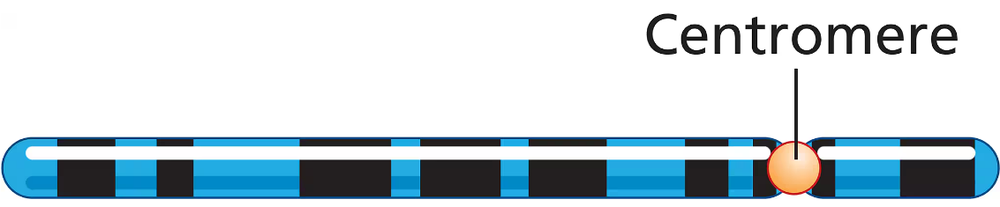
The accompanying chromosome diagram represents a eukaryotic chromosome prepared with Giemsa stain. Indicate the heterochromatic and euchromatic regions of the chromosome, and label the chromosome's centromeric and telomeric regions.
Diagram of a eukaryotic chromosome showing centromere, telomeres, and labeled heterochromatic and euchromatic regions.
Do you expect the centromeric region to contain heterochromatin? Why or why not?

Verified step by step guidance
1
Examine the chromosome diagram and identify the darker-stained regions. These darker regions represent heterochromatin, which is tightly packed DNA, while the lighter-stained regions represent euchromatin, which is less condensed and more transcriptionally active.
Label the centromeric region of the chromosome. The centromere is typically located at the constricted region of the chromosome and is essential for proper segregation during cell division.
Label the telomeric regions of the chromosome. These are located at the ends of the chromosome and serve to protect the chromosome from degradation and fusion with other chromosomes.
Determine whether the centromeric region contains heterochromatin. Recall that centromeres are generally composed of constitutive heterochromatin, which is highly condensed and not transcriptionally active, as it plays a structural role in chromosome segregation.
Explain why the centromeric region is expected to contain heterochromatin. The tightly packed nature of heterochromatin in the centromere provides stability and ensures proper attachment of spindle fibers during mitosis and meiosis.

Verified video answer for a similar problem:

This video solution was recommended by our tutors as helpful for the problem above.
Video duration:
2m
Was this helpful?

Key Concepts

Here are the essential concepts you must grasp in order to answer the question correctly.

Euchromatin and Heterochromatin

Euchromatin is a less condensed form of chromatin that is actively involved in transcription, allowing genes to be expressed. In contrast, heterochromatin is tightly packed and generally transcriptionally inactive, often found in regions of the chromosome that are not expressed. Understanding the distinction between these two types of chromatin is crucial for analyzing chromosome structure and function.
Recommended video:

Centromere and Telomere

The centromere is the region of a chromosome where the two sister chromatids are joined and is essential for proper chromosome segregation during cell division. Telomeres are repetitive nucleotide sequences at the ends of chromosomes that protect them from degradation and prevent fusion with neighboring chromosomes. Identifying these regions helps in understanding chromosome stability and behavior during mitosis and meiosis.
Recommended video:
Guided course
08:38
Telomeres and Telomerase

Giemsa Staining

Giemsa staining is a technique used to visualize chromosomes under a microscope, highlighting differences in chromatin structure. This stain binds to DNA, allowing for the differentiation of euchromatin and heterochromatin based on their staining intensity. The ability to identify these regions through Giemsa staining is essential for analyzing chromosome morphology and understanding genetic disorders.
Related Practice
Textbook Question

A normal chromosome and its homolog carrying a paracentric inversion are shown here. The dot (·) represents the centromere.

Normal    ABC • DEFGHIJK

Inversion  abc • djihgfe

Assume a crossover takes place in the region between F and G. Identify the gametes that are formed following this crossover, and indicate which, if any, gametes are viable.

720
views
Textbook Question

A normal chromosome and its homolog carrying a paracentric inversion are shown here. The dot (·) represents the centromere.

Normal    ABC • DEFGHIJK

Inversion  abc • djihgfe

Assume a crossover takes place in the region between A and B. Identify the gametes that are formed by this crossover event, and indicate which, if any, gametes are viable.

462
views
Textbook Question

The accompanying chromosome diagram represents a eukaryotic chromosome prepared with Giemsa stain. Indicate the heterochromatic and euchromatic regions of the chromosome, and label the chromosome's centromeric and telomeric regions.

What term best describes the shape of this chromosome?

527
views
Textbook Question

The accompanying chromosome diagram represents a eukaryotic chromosome prepared with Giemsa stain. Indicate the heterochromatic and euchromatic regions of the chromosome, and label the chromosome's centromeric and telomeric regions.

Why are expressed genes not found in the telomeric region of chromosomes?

556
views
Textbook Question

The accompanying chromosome diagram represents a eukaryotic chromosome prepared with Giemsa stain. Indicate the heterochromatic and euchromatic regions of the chromosome, and label the chromosome's centromeric and telomeric regions.

Are you more likely to find the DNA sequence encoding the digestive enzyme amylase in a heterochromatic, euchromatic, centromeric, or telomeric region? Explain your reasoning.

561
views
Textbook Question

Histone protein H4 isolated from pea plants and cow thymus glands contains 102 amino acids in both cases. A total of 100 of the amino acids are identical between the two species. Give an evolutionary explanation for this strong amino acid sequence identity based on what you know about the functions of histones and nucleosomes.

475
views