Pearson+ LogoPearson+ Logo
Ch.14 Carboxylic Acids, Esters, Amines, and Amides
Timberlake - Chemistry: An Introduction to General, Organic, and Biological Chemistry 14th Edition
Timberlake14thChemistry: An Introduction to General, Organic, and Biological ChemistryISBN: 9781292472249Not the one you use?Change textbook
Chapter 14, Problem 79d

Propyl acetate is the ester that gives the odor and smell of pears.
d. Use condensed structural formulas to write the balanced chemical equation for the base hydrolysis of propyl acetate with NaOH.

Verified step by step guidance
1
Step 1: Understand the chemical reaction involved. Base hydrolysis of an ester (propyl acetate) with NaOH is a saponification reaction, where the ester reacts with a strong base to produce an alcohol and a carboxylate salt.
Step 2: Write the condensed structural formula for propyl acetate. Propyl acetate is an ester with the formula CH3COOCH2CH2CH3, where the acetate group (CH3COO-) is bonded to a propyl group (CH2CH2CH3).
Step 3: Identify the reactants and products. The reactants are propyl acetate (CH3COOCH2CH2CH3) and sodium hydroxide (NaOH). The products are propanol (CH3CH2CH2OH) and sodium acetate (CH3COONa).
Step 4: Write the balanced chemical equation using condensed structural formulas. Combine the reactants and products: CH3COOCH2CH2CH3 + NaOH → CH3CH2CH2OH + CH3COONa.
Step 5: Verify the equation is balanced. Ensure the number of atoms of each element is the same on both sides of the equation, and confirm the charge balance is maintained.

Verified video answer for a similar problem:

This video solution was recommended by our tutors as helpful for the problem above.
Video duration:
2m
Was this helpful?

Key Concepts

Here are the essential concepts you must grasp in order to answer the question correctly.

Ester Hydrolysis

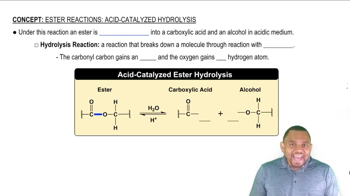
Ester hydrolysis is a chemical reaction where an ester reacts with water to form an alcohol and a carboxylic acid. In the presence of a base, such as sodium hydroxide (NaOH), this reaction is known as saponification. The process involves breaking the ester bond, leading to the formation of the corresponding alcohol and carboxylate salt.
Recommended video:
Guided course
1:14
Acid-Catalyzed Ester Hydrolysis Concept 1

Condensed Structural Formulas

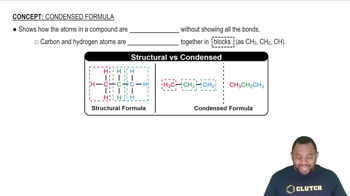
Condensed structural formulas provide a simplified representation of a molecule's structure, showing how atoms are connected without depicting all the bonds explicitly. In these formulas, groups of atoms are often grouped together to indicate their connectivity, making it easier to visualize the molecular structure and understand the reaction mechanisms involved.
Recommended video:
Guided course
1:53
Condensed Formula Concept 1

Balanced Chemical Equations

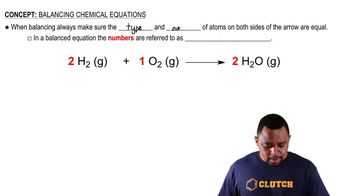
A balanced chemical equation represents a chemical reaction with equal numbers of each type of atom on both sides of the equation. Balancing ensures the law of conservation of mass is upheld, meaning that matter is neither created nor destroyed in the reaction. This is crucial for accurately depicting the stoichiometry of the reaction, which is essential for predicting the amounts of reactants and products involved.
Recommended video:
Guided course
01:32
Balancing Chemical Equations (Simplified) Concept 1