You need 500. mL of a 5.0% (m/v) glucose solution. If you have a 25% (m/v) glucose solution on hand, how many milliliters do you need?
Verified step by step guidance
1
Identify the initial and final concentrations and volumes: Initial concentration (C1) = 25% (m/v), Final concentration (C2) = 5.0% (m/v), Final volume (V2) = 500 mL.
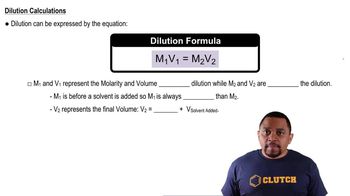
Use the dilution formula: C1 * V1 = C2 * V2, where V1 is the volume of the 25% solution needed.
Rearrange the formula to solve for V1: V1 = (C2 * V2) / C1.
Substitute the known values into the equation: V1 = (5.0% * 500 mL) / 25%.
Calculate V1 to find the volume of the 25% glucose solution required.
Verified video answer for a similar problem:
This video solution was recommended by our tutors as helpful for the problem above
Video duration:
2m
Play a video:
0 Comments
Key Concepts
Here are the essential concepts you must grasp in order to answer the question correctly.
Mass/Volume Percent Concentration
Mass/volume percent (m/v) concentration is a way to express the concentration of a solution. It is defined as the mass of solute (in grams) per 100 mL of solution. For example, a 5.0% (m/v) glucose solution contains 5 grams of glucose in 100 mL of solution, which is crucial for understanding how to prepare or dilute solutions.
The dilution principle states that when a concentrated solution is diluted, the number of moles of solute remains constant before and after dilution. This can be expressed with the formula C1V1 = C2V2, where C1 and V1 are the concentration and volume of the concentrated solution, and C2 and V2 are the concentration and volume of the diluted solution. This principle is essential for calculating how much of a concentrated solution is needed to achieve a desired concentration.
Volume calculation involves determining the amount of a solution required to achieve a specific concentration. In this context, it requires using the dilution formula to find out how many milliliters of the 25% (m/v) glucose solution are needed to create 500 mL of a 5.0% (m/v) solution. Understanding how to manipulate the formula and perform unit conversions is key to solving such problems.