Determine the final volume, in milliliters, of each of the following:b. a 2.0% (m/v) LiCl solution prepared from 50.0 mL of a 10.0% (m/v) LiCl solution
Verified step by step guidance
1
Identify the initial concentration and volume of the LiCl solution: 10.0% (m/v) and 50.0 mL.
Recognize that the final concentration of the LiCl solution needs to be 2.0% (m/v).
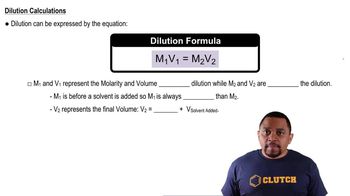
Use the dilution equation: C1V1 = C2V2, where C1 and V1 are the initial concentration and volume, and C2 and V2 are the final concentration and volume.
Substitute the known values into the equation: (10.0%)(50.0 mL) = (2.0%)(V2).
Solve for V2 to find the final volume of the solution.
Verified video answer for a similar problem:
This video solution was recommended by our tutors as helpful for the problem above
Video duration:
2m
Play a video:
0 Comments
Key Concepts
Here are the essential concepts you must grasp in order to answer the question correctly.
Mass/Volume Percent Concentration
Mass/volume percent (m/v) concentration is a way to express the concentration of a solution. It is calculated as the mass of solute (in grams) per 100 mL of solution. For example, a 2.0% (m/v) solution means there are 2 grams of solute in every 100 mL of solution. Understanding this concept is crucial for determining how to dilute or prepare solutions.
The dilution principle states that when a solution is diluted, the amount of solute remains constant, while the volume of the solution increases. This can be expressed mathematically as C1V1 = C2V2, where C is concentration and V is volume. This principle is essential for calculating the final concentration and volume of a solution after dilution.
Volume conversion is the process of changing a volume measurement from one unit to another, such as from milliliters to liters. In this context, it is important to ensure that all volumes are expressed in the same units when performing calculations. Understanding how to convert between units is vital for accurately determining the final volume of a solution.