An aqueous solution that contains 285 ppm of potassium nitrate (KNO₃) is being used to feed plants in a garden. What volume of this solution is needed to prepare 2.0 L of a solution that is 75 ppm in KNO₃?
Verified step by step guidance
1
Understand that ppm (parts per million) is a way to express concentration, where 1 ppm is equivalent to 1 mg of solute per liter of solution.
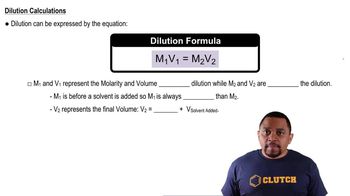
Use the dilution equation, which is based on the principle of conservation of mass: \( C_1V_1 = C_2V_2 \), where \( C_1 \) and \( V_1 \) are the concentration and volume of the initial solution, and \( C_2 \) and \( V_2 \) are the concentration and volume of the final solution.
Identify the given values: \( C_1 = 285 \) ppm, \( C_2 = 75 \) ppm, and \( V_2 = 2.0 \) L.
Rearrange the dilution equation to solve for \( V_1 \): \( V_1 = \frac{C_2 \times V_2}{C_1} \).
Substitute the known values into the equation to find \( V_1 \), the volume of the initial solution needed.
Verified video answer for a similar problem:
This video solution was recommended by our tutors as helpful for the problem above
Video duration:
1m
Play a video:
0 Comments
Key Concepts
Here are the essential concepts you must grasp in order to answer the question correctly.
Parts Per Million (ppm)
Parts per million (ppm) is a unit of measurement used to describe the concentration of a substance in a solution. It indicates how many parts of a solute are present in one million parts of the solution. For example, a concentration of 285 ppm means that there are 285 grams of solute in one million grams of solution, which is equivalent to 285 mg in 1 L of water.
Dilution is the process of reducing the concentration of a solute in a solution, typically by adding more solvent. The dilution equation, C1V1 = C2V2, relates the initial concentration (C1) and volume (V1) of the concentrated solution to the final concentration (C2) and volume (V2) of the diluted solution. Understanding this concept is crucial for calculating how to achieve a desired concentration from a more concentrated solution.
Calculating concentration involves determining the amount of solute present in a given volume of solution. In this context, to find the volume of the original solution needed to achieve a specific concentration in a new volume, one must apply the principles of concentration and dilution. This requires manipulating the dilution equation to isolate the unknown volume, ensuring accurate preparation of the desired solution.