 Back
BackChapter 1: Introduction to Medical Terminology – Structured Study Notes
Study Guide - Smart Notes
 Tailored notes based on your materials, expanded with key definitions, examples, and context.
Introduction to Medical Terminology
Overview of Medical Terms
Medical terminology forms the foundation for communication in healthcare. Understanding the structure and types of medical terms is essential for interpreting and using them accurately.
Three types of medical terms:
Terms built from word parts (e.g., cardiology, tonsillectomy)
Terms based on a person's name (eponyms, e.g., Parkinson disease, Alzheimer disease)
Words formed from common language (e.g., magnetic resonance imaging, irritable bowel syndrome)
Most medical terms are derived from Latin and Greek.
Elements of Medical Terms
Medical terms are constructed from several key elements, each contributing to the term's meaning.
Word roots: The core of the term, often indicating a body part or system.
Prefixes: Added to the beginning, modifying the meaning.
Suffixes: Added to the end, specifying condition, procedure, or disease.
Combining vowels: Used to connect word parts for ease of pronunciation.
Word Roots
Definition and Examples
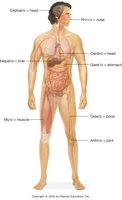
The word root provides the essential meaning of a medical term, often referring to a body part, organ, or system.
arthr: joint
carcin: cancer
cardi: heart
electr: electricity
gastr: stomach
hepat: liver
my: muscle
oste: bone
rhin: nose
Suffixes
Definition and Usage
Suffixes are attached to the end of word roots and provide information about the condition, procedure, or disease.
-ectomy: surgical removal
-gram: record or picture
-itis: inflammation
-logy: study of
-megaly: enlargement
-pathy: disease
Prefixes
Definition and Usage
Prefixes are placed at the beginning of medical terms and modify the meaning, often indicating location, number, or time.
a-: without
bi-: two
dys-: abnormal, difficult, or painful
inter-: between
post-: after
sub-: under
Combining Vowels
Purpose and Rules
Combining vowels (usually 'o') are used to connect word roots and suffixes, making terms easier to pronounce.
Placed between a root and a suffix if the suffix begins with a consonant.
Not used if the suffix begins with a vowel.
Always used between two roots.
Example: arthr + -itis = arthritis (no combining vowel needed)
Example: gastr + o + enter + o + -logy = gastroenterology
Combining Forms
Definition and Application
A combining form is the word root plus the combining vowel, written as root/o (e.g., cardi/o). It is used to build medical terms.
Combining forms are not a separate category but are used for ease of term construction.
Analyzing and Building Medical Terms
Strategies for Analysis
Medical terms can be analyzed by dividing them into their component parts and defining each part.
Divide the word into word parts.
Define each part.
Combine the definitions for the overall meaning.
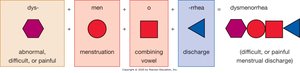
Example: Dysmenorrhea
dys-: abnormal, difficult, or painful
men/o: menstruation
-rrhea: discharge
Definition: Difficult or painful menstrual discharge
Building Medical Terms
To build a medical term, start with the definition, identify the word parts, and assemble them.
Example: Fibrous skin tumor
fibr/o: fiber
dermat/o: skin
-oma: tumor
Assembled as: dermatofibroma
Rules for Building Plurals
General Guidelines
Medical terms follow specific rules for pluralization, often based on Latin or Greek origins. For example, words ending in -a become -ae, and -us becomes -i.
Example: vertebra → vertebrae
Example: nucleus → nuclei
Pronouncing Medical Terms
Guidelines
Pronunciation is important for clear communication. Syllables are divided by slashes (/), and emphasis is placed according to standard rules.
Practice pronouncing terms regularly.
Refer to pronunciation guides as needed.
The Medical Record
Definition and Components
The medical record is a comprehensive document detailing a patient's hospital stay, condition, and treatment. It is a permanent record and includes identification information.
Electronic Medical Record (EMR): Software for entering patient information digitally.
Elements of the Medical Record
Chief complaint
History of present illness
Past medical history
Review of systems
Physical examination (general appearance, vital signs)
Diagnostic data
Assessment and plan
Nurse's notes
Physician's progress notes
Ancillary reports
Diagnostic reports
Operative reports
Pathologist reports
Healthcare Settings
Types of Healthcare Facilities
Healthcare is delivered in various settings, each serving specific patient needs.
Hospitals: Provide diagnostic and treatment services, including emergency and obstetrical care.
Specialty hospitals: Focus on specific diseases (e.g., psychiatric hospitals).
Long-term care facilities: For patients needing extended recovery or unable to care for themselves.
Urgent care centers: Walk-in clinics for immediate, non-emergency care.
Outpatient clinics: Services not requiring overnight stay, including minor surgeries and diagnostic tests.
Physician offices: Diagnostic and treatment services in a private setting.
Health Maintenance Organizations (HMO): Prepaid system with a range of services by primary care physicians and specialists.
Home health care: Nursing, therapy, and personal care in the patient's home.
Rehabilitation centers: Intensive physical and occupational therapy, both inpatient and outpatient.
Palliative care: Relief from pain and symptoms of serious illness.
Hospice: Supportive treatment for terminally ill patients and their families.
